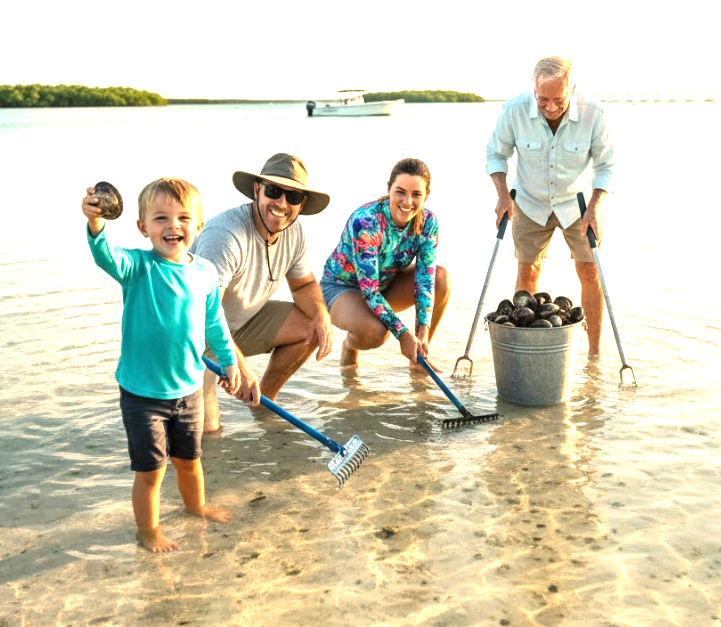
Florida’s coastal waters and estuaries are home to a variety of edible mollusks, making clam harvesting (or clamming) a favorite pastime for locals and visitors alike. While commercial aquaculture drives the state’s main clam production, recreational harvesting is a rewarding way to connect with the environment and enjoy incredibly fresh seafood—provided you know the rules!
Before you grab your rake and bucket, here is what you need to know about the types of clams, where to find them, and the essential regulations set by the Florida Fish and Wildlife Conservation Commission (FWC).
Types of Edible Florida Clams
The clams you’ll be looking for are generally hard-shell clams, commonly known as quahogs. The name quahog refers to the species, Mercenaria mercenaria (Northern hard clam) and Mercenaria campechiensis (Southern hard clam), but local names are based on the size of the clam at harvest:
| Size Classification | Diameter | Best Used For |
| Littlenecks | 1.5″−2″ | Steaming, raw on the half-shell (sweetest and most tender). |
| Topnecks | 2″−3″ | Raw, baked clams, stuffing. |
| Cherrystones | 3″−4″ | Chopping for chowders, soups, and stuffing. |
| Chowder Clams | 4″+ | Chopping for chowder, fritters, and clam sauce (toughest texture). |
Another tiny, but edible, clam found on Florida’s sandy beaches is the Coquina clam (Donax variabilis). These colorful, inch-long clams are often gathered and used to make coquina broth or chowder.
Where to Go Clamming (The Crucial Safety Rule)
The most important rule for clam harvesting—commercial or recreational—is one of public health. Clams are filter feeders, meaning they absorb and concentrate whatever is present in the water, including pollutants and bacteria.
The Shellfish Harvest Areas (SHAs) Rule
- Only harvest from areas designated as “Approved” or “Conditionally Approved” by the Florida Department of Agriculture and Consumer Services (FDACS), Division of Aquaculture.
- These areas are established, monitored, and managed for public health purposes. Harvesting from closed areas is illegal and highly dangerous.
- Always Check the Status: Before heading out, you must check the Daily Status of Shellfish Harvest Areas on the FDACS Division of Aquaculture website or contact the relevant FDACS field office. An area can be closed suddenly due to heavy rainfall (which can introduce runoff) or other water quality issues.
General Locations
Clams thrive in shallow, sandy, or muddy bottom areas in bays and estuaries, typically in the intertidal zone (exposed at low tide).
- Big Bend Gulf Coast: Areas like Dixie, Levy, and Wakulla counties are major clam and oyster producers and often have designated recreational SHAs.
- Southwest Florida: Specific SHAs exist in regions like Pine Island Sound (Lee County) and Gasparilla Sound (Lee/Charlotte County). Always verify the current open/closed status.
- Florida Keys: While famous for lobster and stone crab, some recreational clamming is possible, but check local ordinances closely.
CAUTION: Be mindful of Aquaculture Lease Areas. These are marked areas where clams are commercially farmed. Harvesting clams from these private leases is illegal and strictly prohibited. These areas are typically marked with PVC pipes and signage.
Recreational Regulations and Licensing
To legally harvest clams for personal consumption in Florida, you must adhere to FWC regulations:
1. Licensing Requirements
- Saltwater Fishing License: A valid Florida recreational saltwater fishing license is required for anyone age 16 or older to take or attempt to take clams, crabs, or any other saltwater organism (other than non-living seashells). This is required even if you are harvesting from the shoreline.
2. Gear Restrictions
- Clams are typically harvested using hand tools, such as a clam rake, pitchfork, or shovel.
- The use of dredges or mechanical harvesting devices is generally prohibited for recreational harvesting.
3. Size and Bag Limits
The following limits are for recreational harvesting of hard clams (quahogs). Always check the latest FWC regulations, as they are subject to change.
- Minimum Size Limit: Hard clams must be at least 1 inch thick across the hinge to be legally harvested.
- Bag Limit: The daily bag limit is typically: one 5-gallon bucket per person or two 5-gallon buckets per vessel, whichever is less, per day.
4. Seasonal Closures
While there is generally no set “closed season” for hard clams statewide, harvesting is prohibited whenever a specific SHA is closed due to water quality. Regional closures for oysters and clams often occur in the summer months (e.g., July 1 – September 1 for most of the state).
Clamming Technique: Digging for Treasure
- Look for “Shows”: At low tide, look for tiny holes or indentations in the sand, often in areas of sand/mud near seagrass beds. If you step on a clam, you’ll feel a slight pressure or bulge.
- Rake and Sift: Use a clam rake or shovel to gently loosen and turn over the top few inches of sand/mud.
- Find and Sort: Locate the clam and measure it immediately. Discard any clams that are below the 1-inch minimum size limit.
- Keep Them Alive: Place legal-sized clams in a bucket of fresh seawater. Keep them cool and out of direct sun.
Purging/Cleaning Your Clams
Before cooking, you must purge the clams to encourage them to expel any residual sand.
- Place the clams in a container filled with clean saltwater (not tap water) for a few hours or overnight in a cool, dark place. Adding a small amount of cornmeal can sometimes encourage them to filter more rapidly.
- When ready to cook, scrub the outside of the shells with a brush. Discard any clam whose shell is cracked or does not close tightly when tapped, as it may be dead.
With the proper license, an eye on the latest SHA status, and your clam rake in hand, you’ll be ready to enjoy the freshest seafood Florida has to offer.