
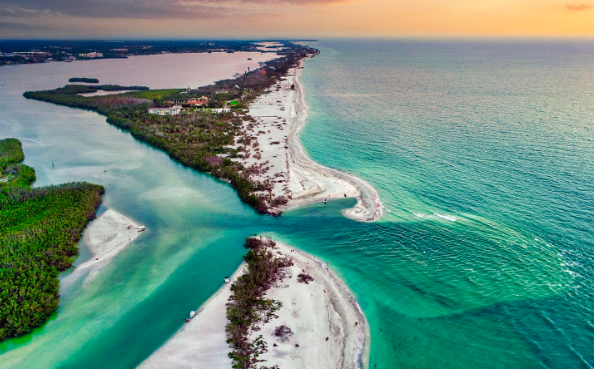

For decades, the stretch of sand between Siesta Key and Casey Key was more than just a beach—it was a battlefield of bureaucracy, environmental advocacy, and the raw power of the Gulf. Known as Midnight Pass, this once-vibrant inlet was silenced by human hands in 1983, only to be dramatically reclaimed by nature during the historic 2024 hurricane season.

As of early 2026, the pass remains a thriving, flowing artery, restoring life to Little Sarasota Bay and offering a case study in how Mother Nature occasionally decides to ignore our zoning permits.
A Tale of Two Keys: The History of the Closure
Historically, Midnight Pass was a natural, shifting inlet that separated Siesta Key and Casey Key. In the mid-19th century, it was known as “Buccaneers Pass,” serving as a critical doorway for water exchange between the Gulf of Mexico and Little Sarasota Bay. Unlike man-made channels, Midnight Pass was a “nomad”—it naturally migrated north and south over the decades in response to tides and storms.
The trouble began in the early 1960s. When the Army Corps of Engineers dredged the Intracoastal Waterway (ICW), the resulting “spoil” (dredged sand and muck) was dumped nearby, disrupting the natural tidal flow. This caused the pass to become unstable and begin a rapid northward migration toward established luxury homes.
By 1983, the shifting inlet was undercutting the Gulf-front properties of two prominent residents: internationally acclaimed artist Syd Solomon and community leader Pasco Carter Jr. Fearful their homes would collapse into the Gulf, they lobbied for permission to close the pass, promising to “relocate” it further south.
- December 1983: With the blessing of the Sarasota County Commission, bulldozers moved in.
- The Result: The pass was filled with sand, but the promised “new” pass never materialized. Nature refused to take the bait, and for the next 41 years, the “plug” remained in place, transforming a flowing inlet into a static beach known locally as Palmer Point.
The Milton Intervention: Nature Takes Back the Tap
For 40 years, the Midnight Pass Society and local environmentalists fought a legal and political war to reopen the pass. The closure had turned Little Sarasota Bay into a “dead zone.” Without the daily flush of the Gulf tides, salinity dropped, water became murky, and the once-thriving scallop and oyster populations vanished.
Following a “pre-breach” by Hurricane Helene in September 2024, Hurricane Milton delivered the final blow on October 9. The massive storm surge and high-energy winds carved through the sand with surgical precision, reconnecting the Gulf to the bay with a force no bulldozer could match.
Environmental & Recreational Benefits
- Water Quality: The stagnant, tea-colored water of Little Sarasota Bay is being replaced by crystalline Gulf water. This “flushing” action helps reduce harmful algal blooms and increases dissolved oxygen.
- Habitat Restoration: Salinity-dependent species like clams, oysters, and scallops are recolonizing the bay floor.
- Seagrass Recovery: Increased water clarity allows sunlight to reach the bottom, fostering the return of Turtle Grass, essential nurseries for marine life.
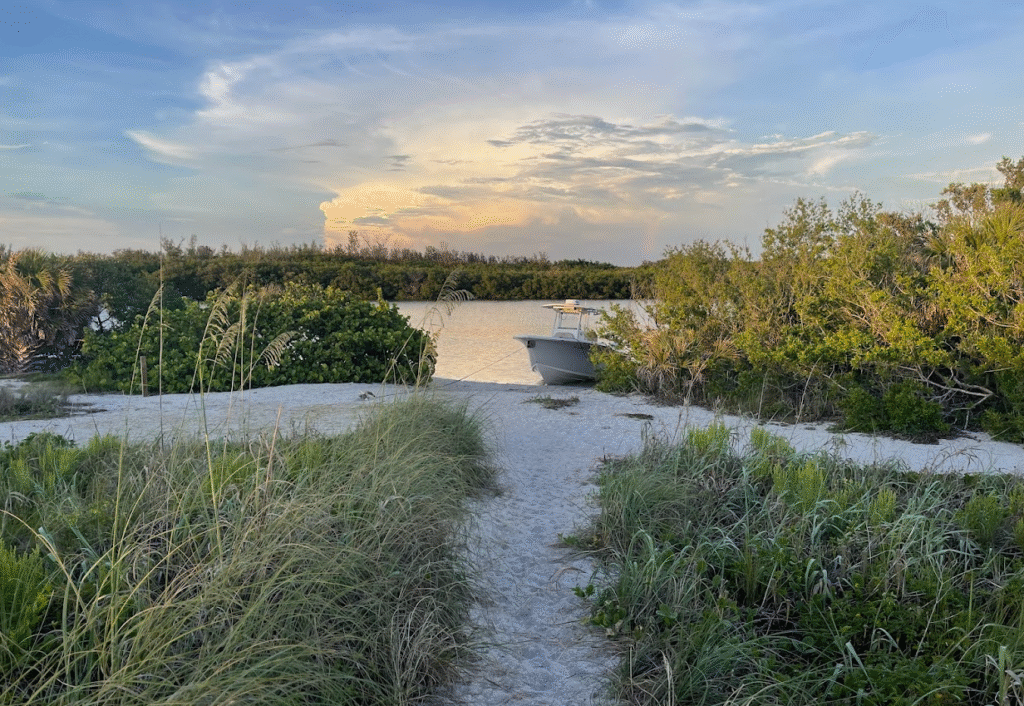
- Boater Access: Boaters can now travel directly from the bay to the Gulf without navigating 10 miles north to Big Pass or south to Venice.
Current Fishing Report: February 2026
The reopening has transformed Midnight Pass into a premier destination for anglers. As of mid-February 2026, the “wild” nature of the inlet is producing some of the most consistent action in Sarasota County.
What’s Biting
- Redfish & Spotted Seatrout: These are the stars of the flats right now. Look for them in “potholes” (deeper sandy spots within grass flats) during negative low tides. As the tide rises, they move onto the shallow flats to feed.
- Sheepshead: The “convict fish” are out in force. They are tightly schooled around dock pilings and the submerged rocks near the pass.
- Pompano: These silver fighters are being caught in the surf just outside the pass and on the deeper grass edges within the bay.
- Snook: While technically out of season for harvest and sensitive to the February chill, they are active at night around lighted docks in the ICW.
Recommended Gear & Tactics
- Bait: Live shrimp is the “gold standard” this month. For sheepshead, use fiddler crabs or blanched sand fleas.
- Artificials: 1/16-ounce CAL Jigs with shad tails or DOA Shrimp are working well. The key is to slow down your presentation; the clear, cool water makes fish more lethargic and cautious.
- Fly Fishing: Use an intermediate sink-tip line with a Clouser Minnow (chartreuse/white) to reach trout and mackerel in the deeper sections of the pass.
Wildlife of the Pass
The area is currently a hotspot for biodiversity. Keep your binoculars ready for these sightings:
| Category | Common Sightings |
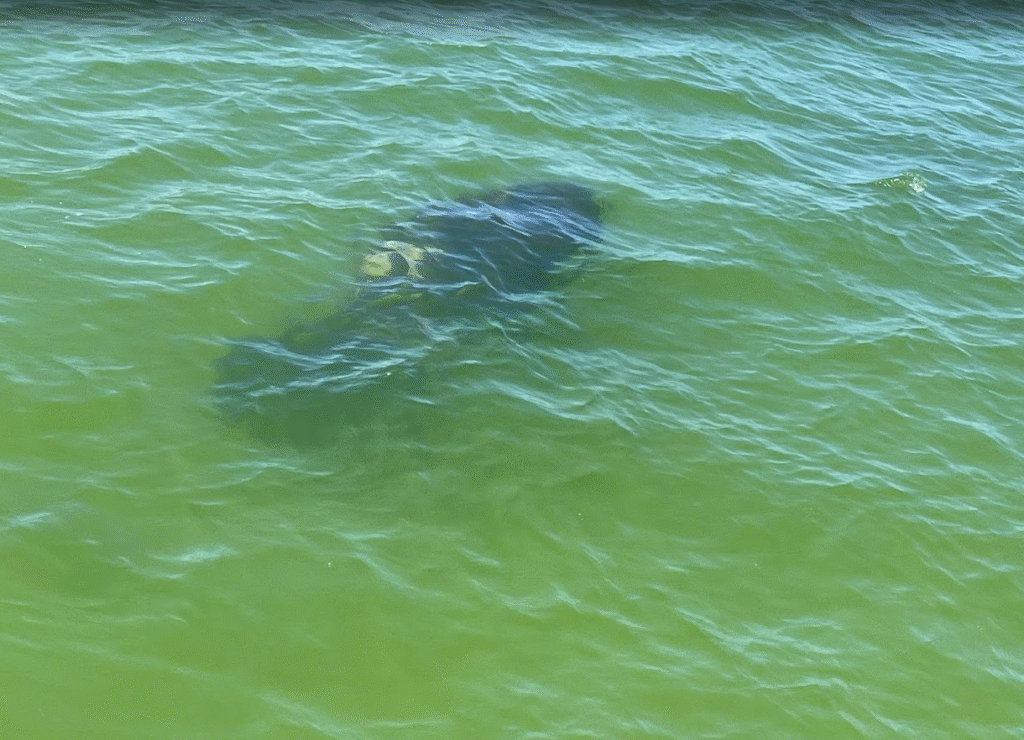
| Marine Mammals | Bottlenose dolphins hunting in the tidal current and Manatees grazing on new seagrass. |
| Sport Fish | Snook, Redfish, Tarpon, and Spotted Seatrout congregating at the inlet to feed. |
| Birds | Roseate Spoonbills, Ospreys, and the endangered Snowy Plover nesting on the nearby dunes. |
| Under the Surface | Spotted Eagle Rays, Bonnethead Sharks, and the return of the Florida Spiny Lobster. |
Safety Tips: Navigating a “Wild” Inlet
Because Midnight Pass was reopened by a storm and not a dredge, it is an unmarked, dynamic inlet.
For Boaters
- Watch for Shoaling: The pass is “wild.” Sandbars move weekly. Use a lookout on the bow and keep your depth sounder active.
- Respect the Current: Tidal flow can exceed $3\text{ ft/s}$ (roughly $2\text{ knots}$). During a peak outgoing tide, small vessels can be swamped by “standing waves.”
- No Markers: Do not rely on old GPS charts. Visual navigation is mandatory.
For Swimmers
- Avoid the Center: Never attempt to swim across the mouth of the pass. The current is strong enough to pull even strong swimmers out to sea.
- The “Stingray Shuffle”: The sandy flats are prime territory for rays. Always shuffle your feet to avoid a sting.
- Shark Awareness: Inlets are “buffets” for sharks like Blacktips and Bulls, especially at dawn and dusk. Avoid swimming near schools of jumping baitfish.
The “Rebirth of Midnight Pass” stands as a powerful reminder: human engineering can pause the rhythms of the earth, but it can rarely stop them forever.