
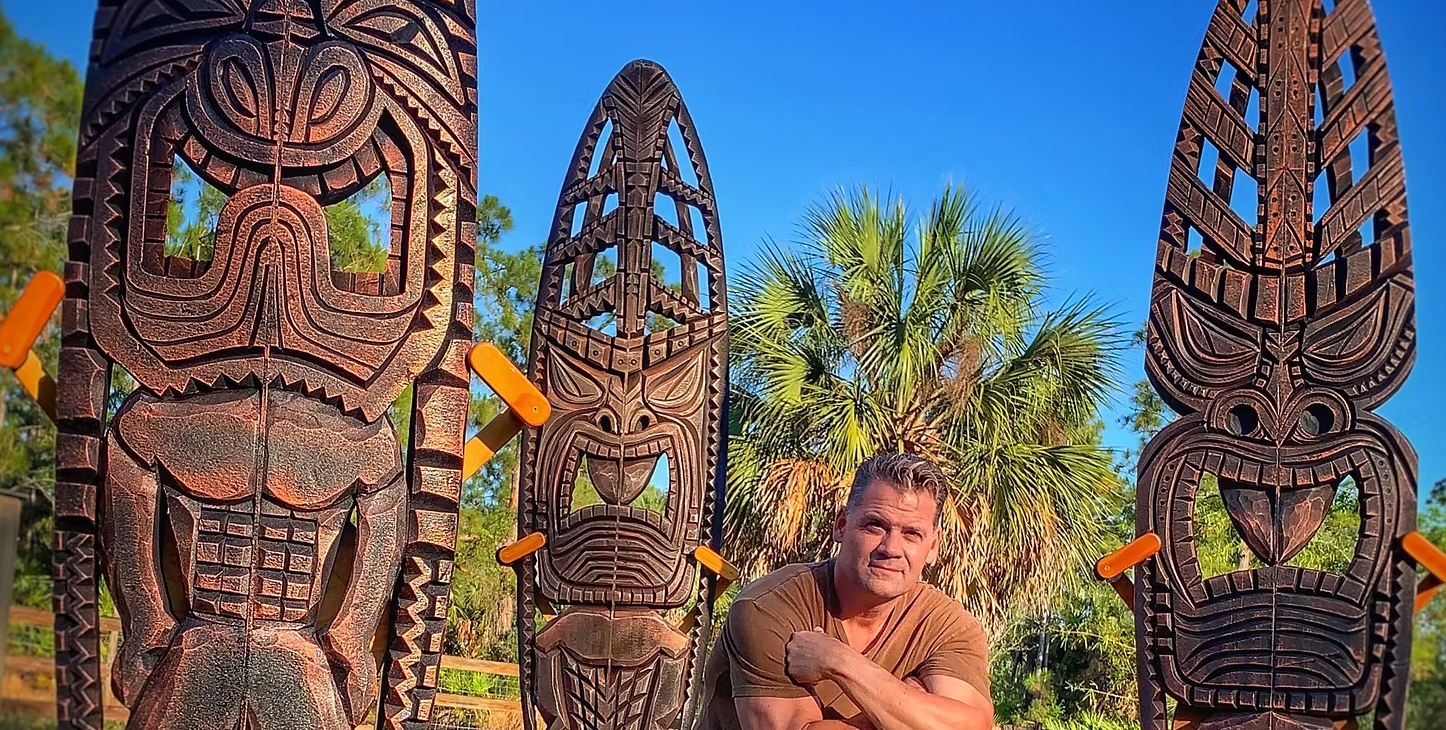
In the coastal city of Naples, Florida, the intersection of surf culture and fine art finds its most vibrant expression in the work of Jake Jones. A former graphic designer who traded his cubicle for a carving tool, Jones has gained a reputation for transforming discarded, battle-worn surfboards into intricate, high-end sculptures.
Through his Fresh Fish Gallery, he breathes new life into “reclaimed” boards, creating a bridge between the surfboard’s history on the waves and its future as a center-piece of coastal decor.
The Background: From Digital to Tangible
Jake Jones’ journey is a classic tale of creative evolution. A California native who moved to Naples in 1989, Jones spent nearly 30 years as a graphic designer and newspaper illustrator. While his career was built on the digital screen, his roots were always tied to the water—a byproduct of a childhood spent around the ocean with parents he jokingly describes as “hippies.”
The shift from digital to physical art began around 2017 as a hobby. Feeling the burnout of decades behind a computer, Jones sought a medium that allowed him to “get his hands dirty.” What started as an experiment in his driveway quickly evolved into a full-time passion. By 2019, he left the corporate world to focus entirely on his surfboard carvings, finding that there was a hungry market for art that carried a tangible piece of surf history.
The Creative Process: A Deep Dive
Unlike artists who simply paint on the surface of a board, Jones’ process is subtractive and reconstructive. He views himself as much a sculptor as a painter.
1. Salvaging the “Canvas”
The process begins with the hunt. Jones scours the internet for used, beat-up surfboards that have reached the end of their functional lives. Often, locals who know his work will simply drop broken or “retired” boards in his driveway.
2. Stripping and Prepping
The most grueling part of the process is the deconstruction. Jones must manually remove the fiberglass shell from the board. This stage is noisy, dusty, and physically demanding, as he strips away the hard exterior to reveal the foam core or “blank” underneath.
3. Hand-Carving the Vision
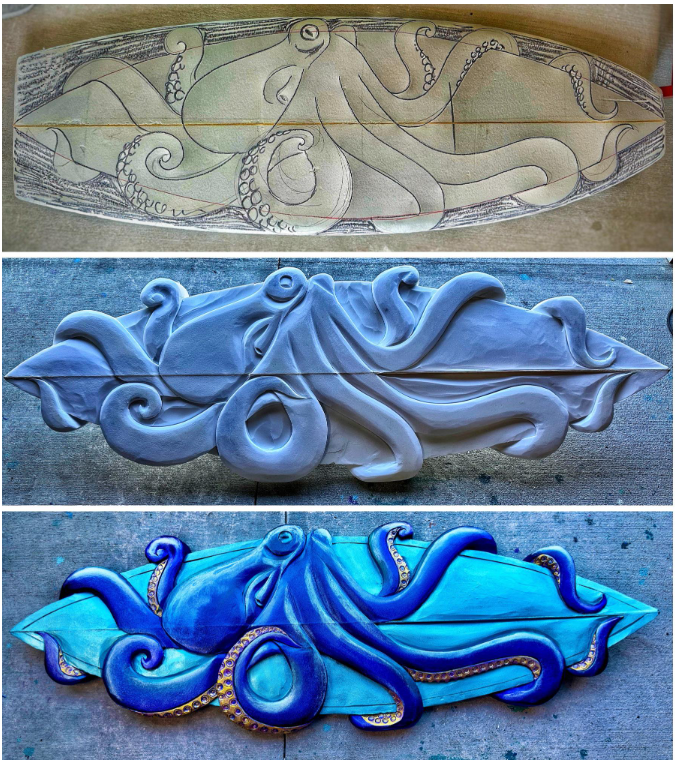
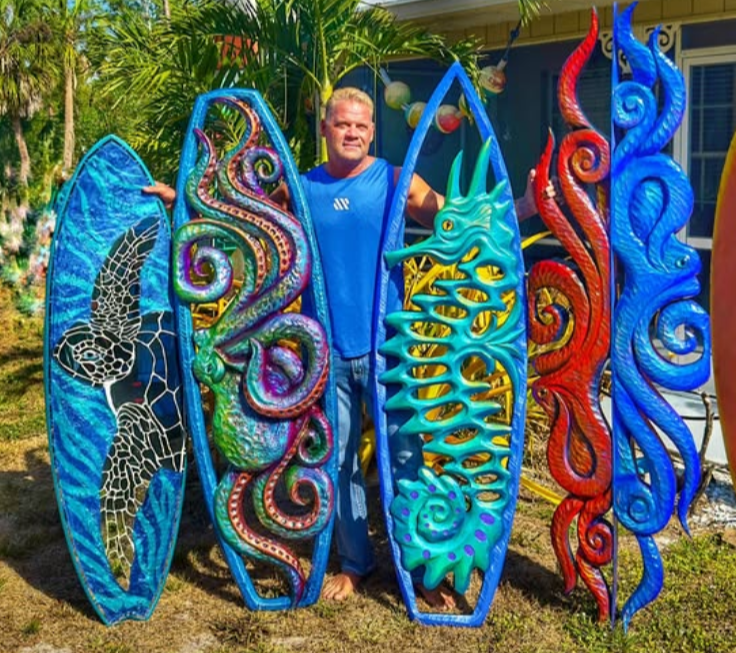
Once the core is exposed, the carving begins. Using various tools, Jones meticulously carves sea life directly into the foam. Common motifs include:
- Sea Turtles (Honu)
- Octopuses (King Kraken)
- Mahi-Mahi and Jellyfish
- Tiki and Tribal iconography
This stage is what sets his work apart; the subjects aren’t just rendered on the board—they emerge from it in three dimensions.
4. Automotive Finishes
To bring the carvings to life, Jones utilizes automotive paints. He favors “candy colors,” pearls, and iridescent finishes typically reserved for custom cars. These paints are ideal for sea life because they mimic the shimmering, translucent quality of fish scales and water. Furthermore, because these paints are designed for vehicles, the finished art is durable enough to withstand the Florida elements, whether displayed in a living room or on a lanai.
5. The Final Seal
The work is finished with a thick, high-gloss epoxy coating. This provides a glass-like sheen that enhances the depth of the colors and pays homage to the original “glassing” process of a functional surfboard.
Legacy Pieces and Meaning
Beyond his standard gallery offerings, Jones has carved out a niche in “Legacy Pieces.” Clients often bring him surfboards that belonged to deceased parents or were used during significant life milestones. By carving these family heirlooms, Jones transforms a sentimental object that might otherwise rot in a garage into a “tree of life” sculpture that can be passed down through generations.
“I love the idea of bringing things back to life,” Jones says. “These boards once carved waves themselves, and now they get to live on as art.”
Where to Find His Work
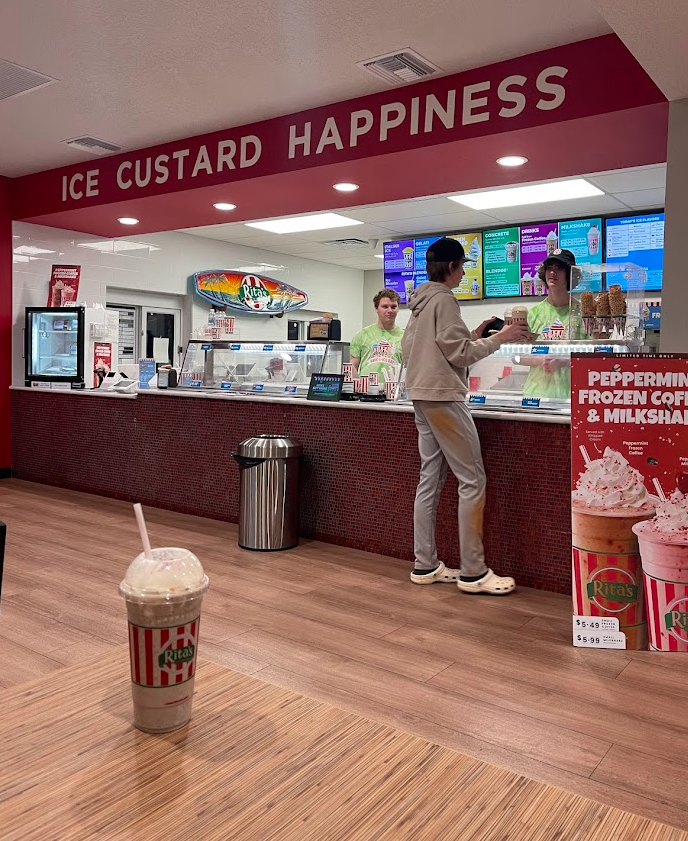
Today, Jake Jones operates through his Fresh Fish Gallery and his official website, Jake Jones Gallery. His works range from “Sea Legs” minis to massive 75-inch wall hangings, often selling for thousands of dollars to collectors as far away as Switzerland. Locally, one of Jake’s works hangs behind the counter at Rita’s Italian Ice on Clark Road in Sarasota.
https://www.facebook.com/share/r/1C51rTSeNE