
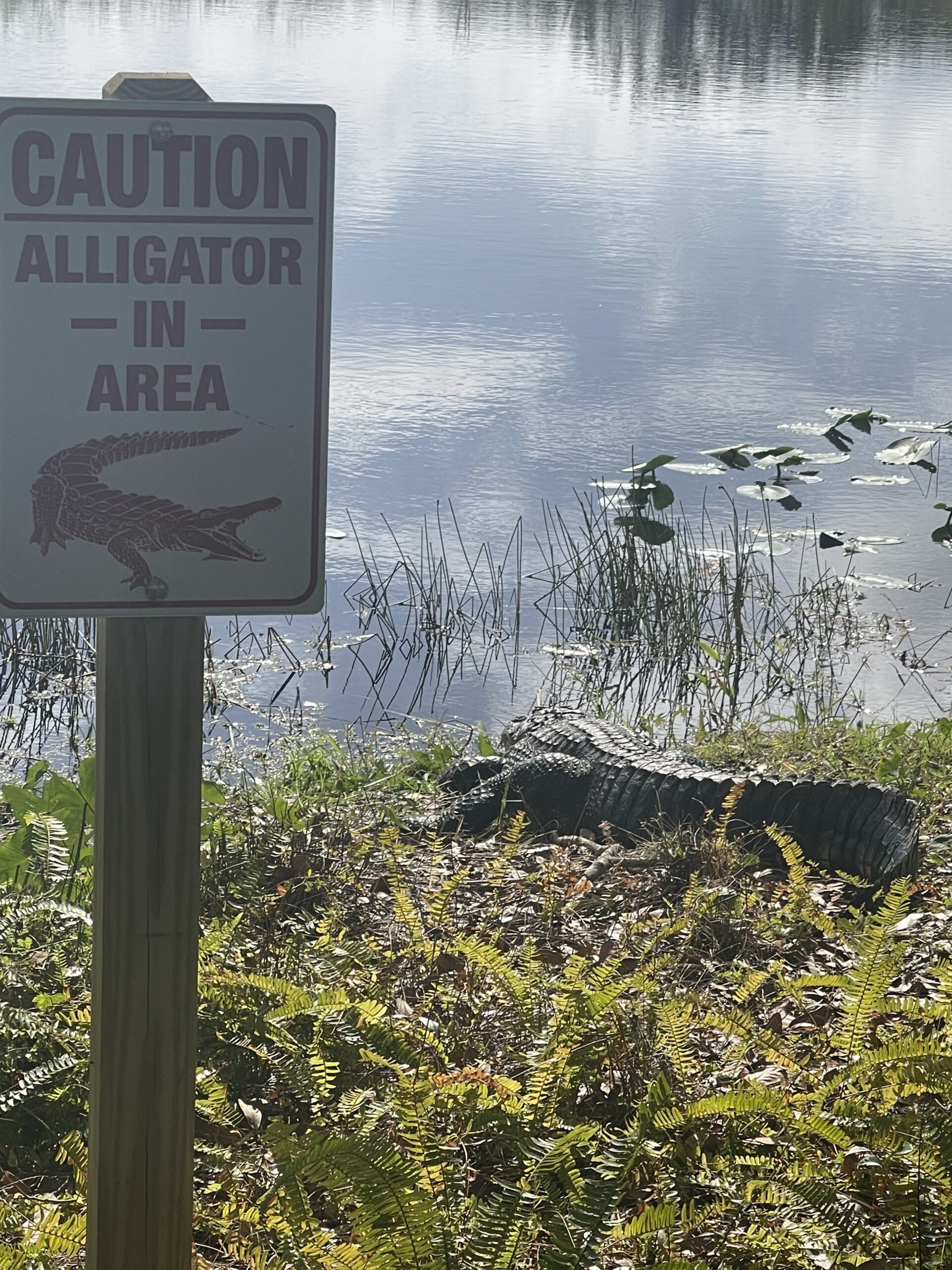

As the humidity rises and the bougainvillea blooms across Southwest Florida, a certain prehistoric neighbor begins to get a bit… restless. We’ve officially entered Alligator Mating Season, a time when Florida’s most famous residents trade their usual stoic sunbathing for loud serenades and cross-country treks in search of love.

While this is a fascinating natural spectacle, it’s also the time of year when “Florida Man” headlines and backyard surprises tend to spike. Here is everything you need to know to stay safe and appreciate the “Gator Gala” from a respectful distance.
The Calendar of Love: Key Dates
In Southwest Florida, the timeline is dictated by the thermometer. As soon as the water consistently hits about 82°F (28°C), the biological clock starts ticking.
- Early April: Courtship begins. Alligators become much more mobile and visible.
- May – June: Peak mating season. This is when vocalizations and territorial behavior reach their height.
- Late June – July: Nesting. Females begin building mounds of vegetation to house their eggs.
- August – September: Hatching season. The “chirping” of baby gators begins.
The “Water Dance” and Other Behaviors
If you live near a canal, lake, or the Everglades, you’re likely to see (and hear) some unusual antics. Alligators don’t just “swipe right”; they put on a full-scale production.
1. The Big Bellow
Male alligators (bulls) produce a deep, throaty roar called a bellow. This sound is so low-frequency it actually makes the water on their backs “dance” or “sprinkle” into the air—a phenomenon known as the water dance. This serves as a GPS beacon for females and a “stay away” warning for rival males.
2. Territorial Trekking
Normally, alligators are homebodies. During mating season, however, males will wander miles away from their usual haunts to find a mate. This is why you suddenly find them in swimming pools, under cars, or crossing I-75.
3. Increased Aggression
While alligators are naturally shy, the surge in hormones makes them more protective of their space. Females, in particular, become “helicopter parents” once the nesting phase begins in June, guarding their mounds with fierce intensity.
Ecological Impact: The “Engineers” of the Glades
It’s easy to view mating season solely as a safety risk, but it is a cornerstone of the Florida ecosystem. Alligators are keystone species, meaning the environment would look drastically different without them.
- Gator Holes: During the mating and dry seasons, alligators use their tails and snouts to excavate depressions in the muck called “alligator holes.” These stay filled with water even during droughts, providing a life-saving oasis for fish, turtles, and wading birds.
- The Carbon Guard: Recent research suggests that by keeping herbivore populations (like nutria and wild pigs) in check, alligators protect the vegetation that stores massive amounts of carbon, helping Florida’s wetlands act as a “lung” for the planet.
- Nesting High-Ground: Alligator nests are often the only dry ground in a swamp. Once a mother gator abandons her nest, other reptiles like turtles and snakes use the decaying mound to incubate their own eggs.
Dangers and Warning Signs
The primary danger during this season isn’t that alligators are “hunting” humans—it’s that they are unpredictable.
- The Pet Factor: Alligators see small dogs and cats as natural prey (similar to a raccoon or opossum). A splashing pet at the water’s edge is an irresistible dinner bell.
- The Dawn/Dusk Trap: Alligators are most active at night and during twilight hours. Low light makes it harder for you to see them and easier for them to ambush prey.
- The “Fed” Gator: The most dangerous gator is one that has been fed by humans. They lose their fear and begin to associate people with food, leading to aggressive “nuisance” behavior.
How to Stay Safe: Expert Tips
You don’t need to live in fear; you just need to live with situational awareness. Follow these specific steps to keep your spring “gator-free”:
| Action | Why it Matters |
| Keep a 60-foot Buffer | If a gator hisses or moves toward you, you are too close. Give them plenty of “personal space.” |
| Leash Your Pets | Never let your dog roam near the edge of a canal or pond, especially in Southwest Florida’s residential neighborhoods. |
| No Swimming at Night | Stick to chlorinated pools after the sun goes down. Freshwater swimming at dusk is high-risk. |
| Dispose of Fish Scraps | If you’re fishing, don’t throw scraps into the water. This “accidental feeding” attracts gators to docks and piers. |
| Run Straight | Forget the myth about running in zig-zags. If an alligator charges (which is rare), run as fast as you can in a straight line away from the water. They are fast in short bursts but tire quickly. |
[!IMPORTANT]
See a Nuisance Gator? If you encounter an alligator over 4 feet long that is acting aggressively or is in a dangerous spot (like your porch), call the FWC’s Nuisance Alligator Hotline at 1-866-FWC-GATOR (392-4286).
Respect the scales, enjoy the “bellows” from a safe distance, and remember: in Southwest Florida, if there is a body of water larger than a puddle, assume there’s a gator in it!

