

Southwest Florida (SWFL) is often synonymous with sunshine and heat, but from late fall through early spring, water and air temperatures can dip enough to make water activities surprisingly chilly—especially with a steady wind!1

Whether you’re kayaking the mangroves, paddleboarding the Gulf, or diving for shells, the key to an enjoyable “cool season” outing is simple: Dress for the water, not the air.
Here is your essential guide to staying warm and comfortable while enjoying the water in Sarasota, Fort Myers, Naples, and the surrounding areas this time of year.
Understanding the Gulf Water Temperature
While air temperatures might peak in the high 60s or 70s during the day, the Gulf water temperature lags behind and can feel significantly cooler.
- Average Winter Water Temperatures: In the SWFL Gulf Coast area, water temperatures typically range from the low to mid-60s°F (17-20°C) in December, January, and February.
- The Wind Chill Factor: A cool breeze over damp skin is the fastest way to feel cold. Even if you’re not fully submerged, wind and splash can quickly drain your body heat.
Gear Strategies for In-Water Activities (Snorkeling, Swimming, Diving)
If you plan to be fully submerged for any length of time, neoprene gear is your best friend. It traps a thin layer of water against your skin, which your body heats up to create insulation.2
1. Wetsuit Selection: Your Thermal Armor
For Southwest Florida waters, you don’t need the heavy suits worn up north, but a wetsuit is highly recommended when water temps are below $70^\circ\text{F}$ ($21^\circ\text{C}$).
- The Go-To Choice: A $3\text{mm}$ full wetsuit is the standard for most Florida winter water activities, offering a great balance of warmth and mobility.
- For the Cold-Sensitive: If you tend to get cold easily, or if the water has dipped into the low $60\text{s}^\circ\text{F}$, a $4/\text{3mm}$ wetsuit (4mm torso, 3mm limbs) provides extra core warmth.
- For Brief Activities: A neoprene jacket or $2\text{mm}$ shorty suit may suffice for quick dips or late-season snorkeling when the air is warmer.
2. Essential Accessories
- Neoprene Accessories: Hands and feet lose heat quickly. Consider neoprene socks or booties (3mm is plenty) and lightweight paddling gloves to maintain circulation and dexterity.3
- The Hooded Vest: For maximum core warmth without the full bulk of a hooded suit, a neoprene hooded vest worn under a full wetsuit can make a big difference.
Layering Strategies for Above-Water Activities (Kayaking, Boating, SUP)
For activities where you expect to stay dry but face wind and splash (kayaking, paddleboarding, fishing from a boat), the strategy shifts to smart layering and blocking wind.
1. The Three-Layer System
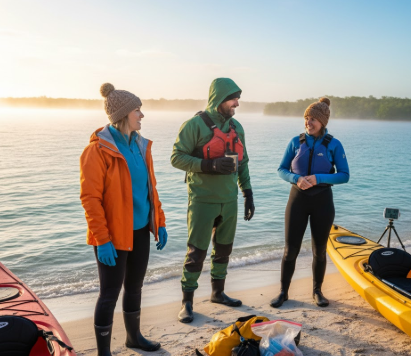
Always wear clothing made of synthetic materials (polyester, nylon, fleece, neoprene) or wool. Avoid cotton, as it holds water and loses all insulating properties when wet.4
- Base Layer (Wicking): A long-sleeved, moisture-wicking top and bottom (like a rashguard or synthetic long underwear) that sits next to your skin. This pulls any sweat or splash moisture away from you, keeping you dry.
- Mid Layer (Insulation): A lightweight fleece jacket or vest. This layer is crucial for trapping heat.
- Outer Layer (Protection): A waterproof, windproof shell (like a light rain jacket or paddling jacket). This is your shield against the cold wind and paddle splash, which is often the biggest source of chill.
2. Key Kayaking/Paddling Tips
- Footwear: Wear neoprene booties or closed-toe water shoes with non-cotton socks underneath.
- Dry Bag Backup: Always pack a complete, dry change of clothes in a waterproof dry bag. If you capsize or get thoroughly soaked, having dry items can prevent a dangerous chill.
- Hat & Gloves: A beanie or warm hat significantly limits heat loss from your head. Lightweight paddling gloves will protect your hands from cold wind and blisters.5
Comfort and Timing Tips for Every Outing
- Time Your Trip: Plan your outing for late morning or early afternoon. Temperatures are usually at their warmest between 10 AM and 3 PM, helping to counteract the water’s chill.
- Pack a Thermos: Bring a thermos filled with hot coffee, tea, or cocoa. A warm drink can instantly raise your core temperature and spirits.6
- Use Hand Warmers: Toss a few disposable hand warmers into your pockets or gloves for quick, concentrated heat.
- Know Your Limits: On particularly cold or windy days, keep your time on the water shorter than you would during summer, and always check the marine forecast before you launch.
By respecting the chill and gearing up properly, you can enjoy Southwest Florida’s beautiful waterways during the quiet, clear-sky days of winter.