

Southwest Florida is a fishing paradise, thanks in large part to its expansive, biologically rich estuarine systems like Charlotte Harbor and the Caloosahatchee River. These estuaries, where freshwater rivers meet the saltwater Gulf of Mexico, create a brackish environment with constantly shifting salinity levels.1 For local anglers, understanding this “salinity shuffle” is key to consistent fishing success.

Salinity—the measure of salt concentration in the water—is one of the most critical factors influencing the behavior, health, and location of the region’s most prized game fish.
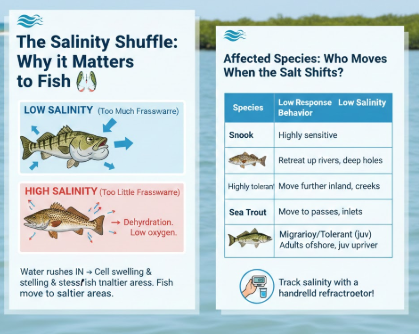
The Science of Salinity: Why it Matters to Fish
Most saltwater species are finely tuned to a specific salinity range.2 When the balance is disrupted, especially by significant freshwater releases from inland systems or by prolonged droughts, fish experience osmotic stress.3
- Low Salinity (Too Much Freshwater): A sudden drop in salt content causes water to rush into a saltwater fish’s body, disrupting its internal chemistry and potentially causing cell swelling.4 To survive, the fish must expend extra energy to regulate its salt-to-water balance, forcing it to seek areas with higher, more tolerable salinity. This is common during the rainy season or after major storm events.
- High Salinity (Too Little Freshwater): During long dry spells, excessive evaporation and reduced freshwater inflow can lead to hypersaline (extra salty) conditions, particularly in shallow, enclosed bays. While not as common in all SWFL estuaries as low salinity events, extremely high salinity can stress fish, reduce vital oxygen levels, and, in places like Florida Bay, lead to devastating seagrass die-offs that destroy habitat.
Affected Species: Who Moves When the Salt Shifts?
Game fish in Southwest Florida’s estuaries are often classified by their salinity tolerance. When the salinity level shifts dramatically, you can expect different species to move to find their comfort zone.
| Species | Primary Salinity Response | Behavior in Low Salinity Conditions |
| Snook | Highly sensitive to cold and low salinity | Retreat far up rivers and canals where they can find a comfortable, stable salinity and warmer water, often concentrating in deep holes or near warm run-offs. |
| Redfish (Red Drum) | Highly tolerant, but prefer mid-range brackish water | Will move up or down the estuary, often pushing further inland than snook, finding pockets of preferred water near feeder creeks or river mouths. |
| Spotted Sea Trout | Less tolerant of extreme shifts | Tend to move out of the very low-salinity upper reaches of the estuary and closer to the passes and inlets where salinity is more stable and higher. |
| Tarpon | Highly migratory and tolerant of low salinity as juveniles | Adults may move offshore or into more stable, higher-salinity coastal waters, though juveniles can be found far upriver. |
| Baitfish (Mullet, Pinfish) | Varies by species | Will follow the ideal salinity band, which in turn dictates where the predators will gather. |
💡 Adjusting Your Strategy: A Fisherman’s Game Plan
Salinity is not something you can see, but you can track it with a simple, affordable handheld refractometer or by keeping a close eye on local water quality reports. Knowing the salinity gradient in your area—where the water is fresher and where it’s saltier—is the key to success.
1. The Low-Salinity Game Plan (After Heavy Rains/Freshwater Releases)
When the upper estuary is flooded with freshwater, your target fish will be pushed to the higher-salinity ‘line’—the transition zone where the salt and fresh water mix.
- Move Downriver/Near the Passes: Concentrate your efforts closer to the Gulf passes and inlets. The fish that are stressed by the fresh water will stack up here, waiting for conditions to normalize.
- Fish Man-Made Structure: Snook and Redfish will often retreat into residential canals, deep creek mouths, and rivers, looking for deeper, more stable pockets of water that hold their preferred salinity. Bridges, docks, and rock piles become concentration points.
- Focus on the Edges: Fish the edges of incoming tides. The incoming tide brings in cleaner, higher-salinity water from the Gulf, and fish will often move to the front of this tide to feed.
- Slow Down: Fish are often lethargic under stressful conditions. Use slower retrieves and smaller, more subtle presentations with bait like live shrimp or cut bait.
2. The High-Salinity Game Plan (During Droughts/Dry Spells)
While less common in large parts of SWFL, high salinity forces fish further upriver, closer to the source of fresh water.
- Move Upriver/Inland: Target areas that are normally considered freshwater or oligohaline (very low salinity), such as far-up feeder creeks, residential canals, and river backwaters. Game fish will venture into these areas to escape the overly salty, warm water near the coast.
- Look for Fresh Water Sources: The outfalls of culverts, small creeks, and any source of a freshwater trickle can create a micro-environment with ideal salinity, attracting both bait and predators.
By understanding the delicate balance of salinity in Southwest Florida’s estuaries, anglers can move past simply fishing a spot and start fishing the conditions, turning environmental challenge into fishing opportunity.