
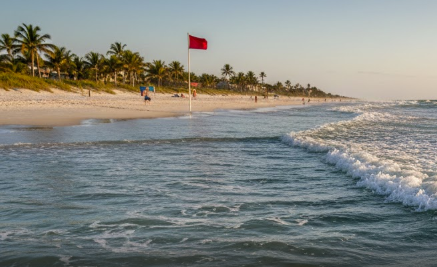

The Gulf of Mexico is often perceived as a “giant swimming pool” because of its emerald-green, tranquil appearance. However, Southwest Florida (SWFL) beachgoers frequently underestimate the power of the Gulf’s rip currents. While our waves may be smaller than those on the Atlantic coast, the underwater topography and tidal shifts create powerful, narrow channels of water that can pull even the strongest swimmers away from the shore.

Identifying the Risk: The Beach Flag System
Before you even touch the sand, check the beach warning flags. In Florida, these are standardized to help you assess daily risks at a glance:
| Flag Color | Hazard Level | Meaning |
| Double Red | Extreme | Water is closed to the public. Do not enter. |
| Single Red | High | High surf and/or strong currents. “Knee-deep is too deep.” |
| Yellow | Medium | Moderate surf and/or currents. Exercise caution. |
| Green | Low | Calm conditions. Always stay alert. |
| Purple | Marine Life | Dangerous marine life (jellyfish, stingrays, or sharks) present. |
Specific Danger Zones in Southwest Florida
While a rip current can form at any beach with breaking waves, certain areas in SWFL are notorious for “permanent” or frequent rips due to man-made structures and natural passes.
1. Jetties and Piers
Rip currents are almost always present near hard structures. The water hitting these obstacles has nowhere to go but out.
- Venice North Jetty & South Jetty: A major “hot spot.” The interaction between the inlet and the jetties creates significant seaward pull.
- Naples Pier: Be extremely cautious when swimming near the pilings.
2. Inlets and Passes
Areas where the Gulf meets a bay or pass are subject to intense tidal currents that mimic rip currents.
- Blind Pass (Sanibel/Captiva): Known for severe rip currents and a lack of lifeguards. The water here moves fast and deep very quickly.
- Boca Grande Pass: The southern tip of Boca Grande is famous for its “No Swimming” signs—heed them.4 The currents here are some of the strongest in the state.
- Big Hickory Pass (Bonita Springs): Shifting sandbars near the pass can create “flash rips” during outgoing tides.
3. Deep Drop-Offs
Beaches like Nokomis, Venice, and Manasota have a quicker drop-off than the shallow slopes of Siesta Key.5 This can give swimmers a false sense of security; one step you are in waist-deep water, the next you are in a “feeder” current pulling you into a rip.
How to Spot a Rip Current
You don’t need a degree in oceanography to see a rip current. Look for these four visual cues:
- A “Gap” in the Waves: A calm-looking area where waves are not breaking, while waves are breaking on either side.
- Discolored Water: A streak of water that looks murkier, darker, or more “churned up” than the surrounding area.
- Moving Debris: Seaweed, foam, or bubbles moving steadily away from the shoreline into the open Gulf.
- Choppy Water: A surface that looks like a “river of sand” flowing outward.
Self-Rescue: Break the Grip of the Rip
If you feel yourself being pulled away from the shore, do not panic. A rip current will not pull you underwater; it will only pull you away from the beach.
- Don’t Fight the Current: The biggest mistake is trying to swim straight back to shore. You will exhaust yourself and increase the risk of drowning.
- Swim Parallel: Swim sideways, parallel to the shoreline. Rip currents are typically narrow (50–100 feet wide). Once you are out of the pull, you will feel the water become calmer.
- The “Flip and Float” Method: If you are too tired to swim, flip onto your back and float. Let the current take you out until it dissipates (usually just past the breaking waves). Then, swim back to shore at an angle.
- Signal for Help: Face the shore, wave your arms, and yell.
Pro Tip: Always swim near a lifeguard. If you are at an unpatrolled beach (like parts of Captiva or Longboat Key), never swim alone and always bring a flotation device.