
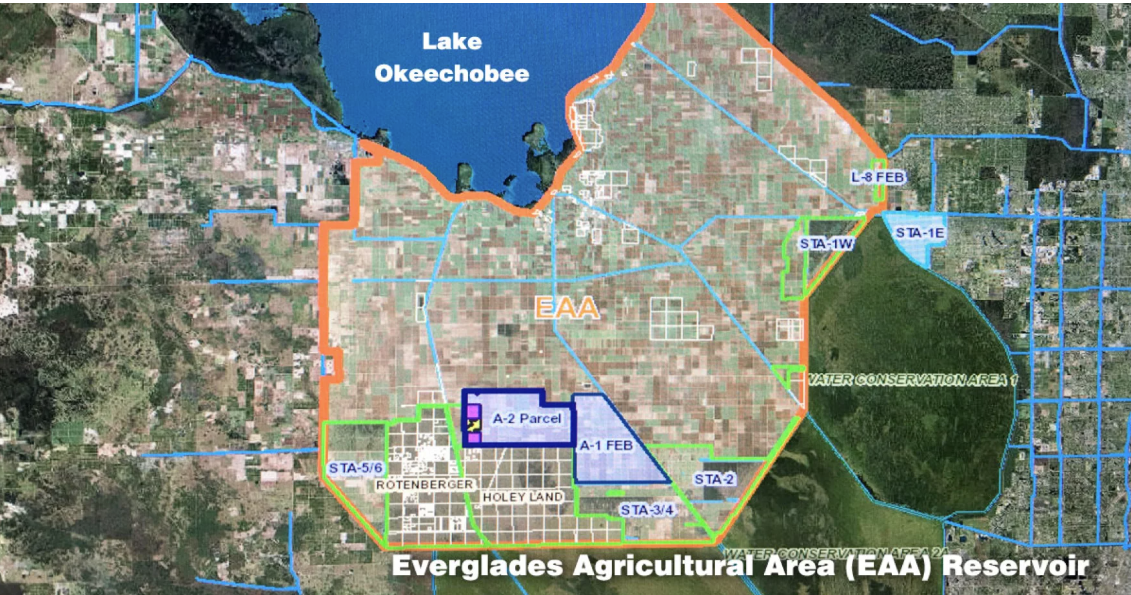
Often called the “crown jewel” of the Comprehensive Everglades Restoration Plan (CERP), the Everglades Agricultural Area (EAA) Reservoir project is a multi-billion-dollar engineering marvel designed to fix the “plumbing” of South Florida. By capturing, cleaning, and moving water south, the project aims to end the destructive cycle of coastal discharges and restore the lifeblood of the Everglades.
A History of Evolution: From CERP to SB 10
The vision for the EAA Reservoir began with the Water Resources Development Act of 2000, which authorized CERP as a 50/50 partnership between the federal government and the State of Florida. However, for nearly two decades, the project remained largely on paper due to funding hurdles and land-use debates.
The true turning point came in 2017 with the passage of Florida Senate Bill 10 (SB 10). Spurred by catastrophic toxic algae blooms, the bill provided $800 million in state funding and a mandate to utilize state-owned land (the A-2 parcel). By April 13, 2026, a historic fast-track announcement confirmed that the state and federal government had synchronized efforts to move the completion date up from 2034 to 2029.
Ecological Impact: Healing the Flow
The ecology of Florida depends on a delicate balance of water quantity and quality. The EAA Reservoir acts as a “buffer” for Lake Okeechobee, fundamentally changing how water moves through the state:
- Reducing Toxic Discharges: Currently, when Lake Okeechobee levels get too high, water is dumped into the Caloosahatchee (west) and St. Lucie (east) rivers. This nutrient-rich water often triggers blue-green algae. The reservoir will reduce these harmful discharges by up to 55%.
- Restoring the “River of Grass”: The project will send an average of 120 billion gallons of clean, fresh water south annually. This restores the historic flow to the central Everglades, which has been parched for decades.
- Florida Bay Salinity: By delivering water to the southern tip of the state, the project prevents “hypersalinity” in Florida Bay, which is essential for the survival of seagrass beds.
The “Marsh Magic”: How the Water is Cleaned
The project isn’t just about moving water; it’s about cleaning it. The Stormwater Treatment Area (STA)—a 6,500-acre man-made wetland—acts as a giant set of kidneys. The goal is to “scrub” phosphorus from over 100 parts per billion (ppb) down to a pristine $10$ ppb.
Stage One: Emergent Aquatic Vegetation (EAV)
Plants like Cattails and Bulrush act as a physical barrier. They slow the water down, allowing phosphorus-heavy sediment to sink to the bottom. The plants also “eat” the phosphorus to grow, locking it into their stalks.
Stage Two: Submerged Aquatic Vegetation (SAV)
Underwater plants and Periphyton (a mix of microbes and algae) perform the final polish. During photosynthesis, they raise the water’s pH, causing phosphorus to bind with calcium and form calcium carbonate ($CaCO_3$). This compound sinks to the floor, permanently burying the phosphorus in the “muck” as long as the marsh remains wet.
The Economy of Clean Water
In Southwest Florida, the environment is the economy. The EAA Reservoir is the primary defense for the region’s “Clean Water Economy.”
- Real Estate: During past algae crises, Lee and Martin counties saw nearly $2 billion in potential property value lost. This project provides “economic certainty” for the hospitality and real estate markets in Fort Myers, Sanibel, and Naples.
- Commercial and Recreational Fishing: Florida Bay sustains a $116 million annual commercial fishing industry. By preventing seagrass die-offs, the reservoir protects the populations of pink shrimp, bonefish, and tarpon.
Specific Areas of Benefit
| Area | Primary Benefit |
| Caloosahatchee River | Massive reduction in nutrient-heavy discharges, protecting estuaries from algae. |
| Florida Bay / The Keys | Reintroduction of fresh water to lower salinity and prevent seagrass “yellow-outs.” |
| Biscayne Aquifer | Improved water flow recharges the aquifer, protecting drinking water for millions. |
| Western Everglades | Enhanced hydration for wildlife habitats, including the Florida panther. |
Project Milestones: The Road to 2029
The project covers approximately 17,000 acres—an area larger than Manhattan.
- 2000: Initial authorization under CERP.
- 2017: SB 10 signed into law, providing state funding and land.
- 2021: Groundbreaking for the 6,500-acre STA.
- 2023: Groundbreaking for the 10,500-acre Reservoir.
- January 2024: Completion of the STA (the “filter”).
- April 13, 2026: Final “Fast-Track” agreement signed to accelerate completion to 2029.
- 2029: Targeted Full Project Completion and operation.
Summary & How to Stay Informed
The EAA Reservoir Project is the linchpin of Everglades restoration. It solves the dual crisis of too much water in the coastal estuaries and too little water in the southern marshes. By using “marsh magic” to clean billions of gallons of water, it protects Florida’s multi-billion dollar tourism and fishing industries.
How to Stay Informed:
- SFWMD Project Dashboard: Visit the South Florida Water Management District for real-time construction updates and drone footage.
- USACE “Jax Strong” Portal: Follow the U.S. Army Corps of Engineers for technical milestones regarding the reservoir’s massive embankments.
- Captains for Clean Water: This advocacy group offers “boots-on-the-ground” updates on how construction is currently affecting water quality in Southwest Florida.
