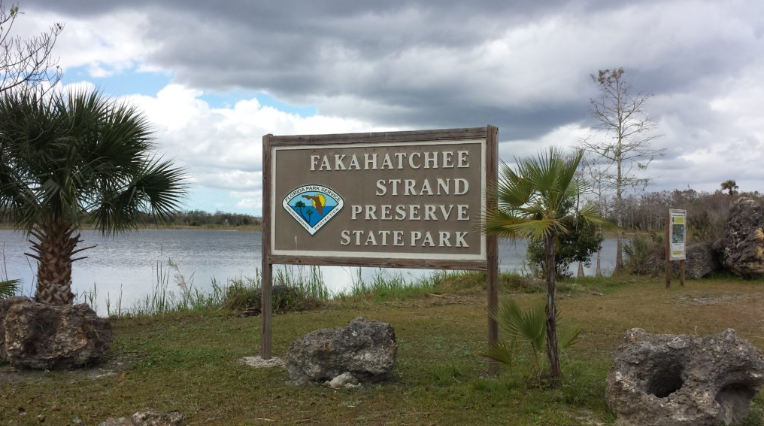
Drive west on US-41 through Collier County on a summer evening and you’ll pass a road sign that reads “Fakahatchee Strand Preserve State Park” with an arrow pointing north into what looks like an endless wall of dark vegetation. Most drivers keep going. The ones who turn find something that takes years to fully understand.
Fakahatchee Strand is a 85,000-acre state preserve containing the largest strand swamp forest in North America and the highest concentration of native orchid species and bromeliad species of any location in the continental United States. It has been called the “Amazon of North America,” the “orchid capital of the continent,” and the last great wild place that most Floridians have never heard of. All of these descriptions are accurate.
This is a guide to what the Fakahatchee is, what lives there, and how to experience it — whether you have two hours or two days.
What Is a Strand Swamp?
A strand is a linear swamp forest that follows a subtle topographic depression in the flat limestone shelf of South Florida, carrying freshwater south and southwest in a broad, slow-moving sheet flow. Unlike a river, a strand has no defined channel — the water seeps and spreads through the forest floor at a pace measured in feet per day.
The Fakahatchee Strand runs approximately 20 miles north to south and 3 to 5 miles wide, carrying water from the watershed near Immokalee southward toward the mangrove coast and the Ten Thousand Islands. This slow flow maintains the darkness and moisture that the extraordinary botanical communities of the strand require.
The forest itself is primarily bald cypress and pop ash, with royal palm hammocks scattered through the interior. The trees are draped in Spanish moss, wild pine bromeliads, and the approximately 44 native orchid species that make Fakahatchee botanically unlike anywhere else north of the tropics.
The Ghost Orchid
No conversation about Fakahatchee is complete without addressing the ghost orchid (Dendrophylax lindenii) — perhaps the most famous plant in Florida and the reason many people make pilgrimages to this preserve from across the country.
The ghost orchid is extraordinary not just for its rarity but for its biology. It has no leaves. It photosynthesizes partly through its green, flattened roots, which cling to the bark of cypress and pop ash trees in a way that makes the plant nearly invisible when not in bloom. It produces no nectar and relies on a single pollinator — the giant sphinx moth — to fertilize its flowers. It blooms unpredictably, typically between June and August, and some individual plants go years between flowering events.
When a ghost orchid does bloom, the result is a single white flower (occasionally multiple flowers) that appears to float in mid-air above the dark water of the swamp, supported by a nearly invisible stem. The flower’s shape — elongated white petals arranged around a frog-like central structure — is considered by botanists and naturalists to be among the most beautiful of any plant on Earth.
There are an estimated 2,000 ghost orchid plants in Florida, the majority of them in Fakahatchee Strand. The preserve has become the primary location for ghost orchid monitoring, research, and conservation.
How to see a ghost orchid: This is the question every visitor asks. The honest answer is that it takes time, knowledge, local guidance, and some luck. Options include:
- Guided swamp walks offered by Fakahatchee Strand State Park rangers and volunteer naturalists from June through August. These led tours involve wading into the swamp to access interior hammocks where known ghost orchid plants are monitored. Pre-registration required; check the park website.
- Jane’s Scenic Drive provides some viewing from the road margin, though most orchid plants are in the interior swamp forest.
- Independent swamp exploration for experienced naturalists who can navigate off-trail in flooded terrain — not recommended without prior guided experience.
Royal Palm Hammocks
The other signature botanical community of the Fakahatchee is the royal palm hammock — isolated stands of Florida royal palm (Roystonea regia) growing naturally within the strand swamp. These towering palms, with their smooth silver trunks rising 60–80 feet before exploding into a crown of arching fronds, are the most dramatic trees in South Florida and occur nowhere else in the continental United States in natural settings except Fakahatchee and a few isolated hammocks in the broader Everglades.
Several royal palm hammocks are accessible from Jane’s Scenic Drive and are among the most photographically compelling subjects in all of South Florida outdoor photography. The contrast of the smooth, luminous silver trunks against the dark swamp water and the lush green canopy above creates compositions that require no artistic embellishment.
How to Visit: Your Options
Option 1: Jane’s Scenic Drive (The Road Walk)
What it is: A 12-mile, one-lane unpaved road through the heart of the strand, passable by standard vehicle in dry season and open to walking, cycling, or driving.
Access: The main entrance is off Janes Memorial Road (County Road 837), approximately 8 miles north of US-41 between Naples and Everglades City. Turn right onto the unpaved road and follow it through the preserve.
What you’ll see: The road passes through open prairie sections, dense strand forest, royal palm hammocks, and areas where the vegetation crowds the road closely enough that you can observe bromeliads and orchids from the road margin. Wildlife viewing from the vehicle or roadside includes alligators, river otters, white-tailed deer, and a wide variety of wading birds. Roseate spoonbills are regular in the wet season.
Time commitment: The full 12 miles at a birding pace takes 3–5 hours on foot. Driving through takes 45–60 minutes. Cycling at a relaxed pace takes 2–3 hours.
Surface conditions: In dry season (November–April), the road is firm and easily walkable. In wet season, portions are deeply flooded and require either wading or a high-clearance vehicle.
Option 2: Big Cypress Bend Boardwalk
What it is: A 2,000-foot elevated boardwalk over the western edge of the strand, providing swamp-level access without getting wet.
Location: On the south side of US-41 at the junction with SR-29, approximately 20 miles east of Naples near Copeland. GPS: 25.9019° N, 81.4128° W.
What you’ll see: The boardwalk extends over black, tannic swamp water through a forest of large bald cypress draped with wild pine bromeliads and Spanish moss. Alligators are frequently visible in the water below. Wood storks, great blue herons, and limpkins use this section regularly. The scale and atmosphere of the swamp is immediately apparent — even a 20-minute walk here conveys the Fakahatchee’s unique character in a way that no photograph fully prepares you for.
Time commitment: 30 minutes to 2 hours depending on pace and wildlife activity.
Facilities: Small parking area on the highway shoulder. No restrooms. Free access.
Option 3: Guided Swamp Walks
What it is: Wade-in guided tours led by park rangers or trained volunteer naturalists into the interior of the swamp forest, reaching habitats inaccessible by trail or boardwalk.
Who it’s for: Anyone who wants the deepest, most immersive Fakahatchee experience — walking through knee-to-thigh-deep dark water beneath the canopy of ancient cypress, surrounded by orchids and bromeliads at close range.
Logistics: Tours are offered seasonally, primarily in spring (April–May) and summer ghost orchid season (June–August). Groups are small. Waterproof footwear or old shoes you don’t mind soaking are essential. Check the Florida State Parks website or call the park office directly for current tour schedules.
The experience: Former participants consistently describe guided swamp walks as the most otherworldly outdoor experience they’ve had in Florida. The combination of water immersion, close-range orchid and bromeliad observation, and the total envelopment of the old-growth cypress canopy is difficult to describe and impossible to forget.
The Bromeliads
While the ghost orchid captures the spotlight, the bromeliads of Fakahatchee deserve their own recognition. The strand supports one of the highest densities of epiphytic bromeliads in the continental United States — with wild pine species, Spanish moss, and stiff-leafed bromeliads covering virtually every surface of every tree in the interior forest.
These plants are not parasites. They are air plants, drawing water and nutrients from the atmosphere and from the organic debris that collects in their centers. The accumulated water in their central cups supports entire micro-ecosystems of insects, tree frogs, and small invertebrates — a community within a community within a community that reflects the almost fractal complexity of the Fakahatchee’s biological richness.
Wildlife Beyond the Plants
The Fakahatchee’s botanical fame can overshadow its equally impressive wildlife profile.
Florida black bear — one of the highest density black bear populations in Southwest Florida. Bears are regularly seen crossing Jane’s Scenic Drive and are heard crashing through the understory during early morning hours. They are non-aggressive when given appropriate space.
Florida panther — the strand sits within active panther territory. Panthers are almost never seen but trail cameras maintained by FWC and park staff confirm their regular movement through the preserve. The knowledge of their presence is part of the Fakahatchee’s wildness.
American crocodile — the brackish water areas near the southern end of the preserve where freshwater meets tidal influence occasionally support American crocodiles, a species far rarer than its alligator cousin and found only in extreme South Florida.
Everglades snail kite — an endangered raptor that specializes entirely on apple snails. The strand’s freshwater areas support apple snail populations and occasional snail kite sightings.
Bird diversity — over 200 species have been documented in Fakahatchee Strand, including breeding populations of several species that require large intact wetland forests: barred owl, red-shouldered hawk, swallow-tailed kite, limpkin, and multiple woodpecker species.
Practical Information
Address: Fakahatchee Strand Preserve State Park, 137 Coastline Drive, Copeland, FL 34137
Phone: (239) 695-4593
Hours: Daily 8:00 AM to sundown
Fee: Free for Jane’s Scenic Drive and Big Cypress Bend Boardwalk. Guided programs may have fees.
Website: floridastateparks.org/parks-and-trails/fakahatchee-strand-preserve-state-park
Key advice: This is not a groomed, managed visitor experience. Cell service is poor or absent through most of the preserve. Carry a paper map or downloaded offline map if exploring beyond the main road. Tell someone where you’re going and when to expect you back. The Fakahatchee rewards preparation and patience with experiences that have no equivalent in the managed outdoor recreation landscape of South Florida.