
In the diverse saltwater environments of Southwest Florida, the right fishing rig can make all the difference between a frustrating day and a successful catch. A “rig” simply refers to the terminal tackle setup at the end of your fishing line, including leaders, weights, hooks, and floats. Understanding how to adapt these components to target specific species and locations is a hallmark of a seasoned angler.

Here’s a breakdown of common saltwater fishing rigs and how to best deploy them across SWFL’s varied waters.
The Foundation: Leaders and Knots
Before diving into specific rigs, remember the importance of your leader. This is a section of monofilament or fluorocarbon line tied to the end of your main line.
- Why use a leader? It’s less visible to fish, more abrasion-resistant against teeth and structure, and typically has a lower breaking strength than your main line, allowing you to break off just the leader if snagged.
- Leader Material:
- Fluorocarbon: Less visible underwater, very abrasion-resistant. Excellent for clear water and spooky fish (like permit or clear-water snook).
- Monofilament: More stretch, good knot strength, generally more affordable. Often used for heavier tackle or less finicky fish.
- Leader Strength: Varies by target. 20−30lb for trout, 30−50lb for snook/redfish, 60−80lb+ for tarpon or larger offshore species.
- Key Knots: Learn the FG knot (for main line to leader connection), uni knot, improved clinch knot, or palomar knot (for leader to hook/swivel).
Essential Saltwater Rigs for Southwest Florida
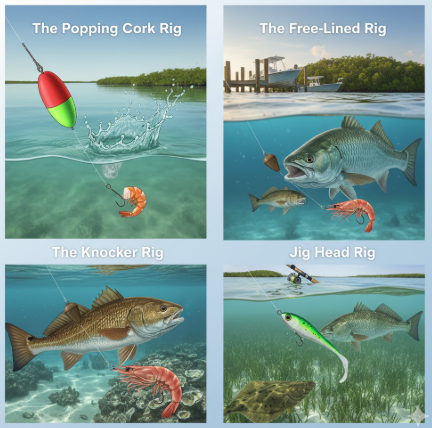
1. The Popping Cork Rig (Trout, Redfish, Snook)

- Setup: A floating cork (often with an inverted cup shape on top) slides or clips onto your main line. Below the cork, a leader (typically 2−4ft) is tied to a hook with live bait (shrimp, small baitfish) or a jig.
- How it Works: You cast it out and periodically “pop” the cork by jerking your rod tip. This creates a splashing, “chugging” sound that mimics feeding baitfish, attracting predatory fish to your bait or lure. The cork also keeps your bait suspended at a desired depth.
- SWFL Application:
- Species: Primarily Spotted Sea Trout on grass flats, but also highly effective for Redfish and smaller Snook along mangrove edges, especially in areas like Pine Island Sound and Charlotte Harbor.
- Location Specifics: Ideal over shallow (2−6ft) grass flats where fish are cruising. Also effective when sight fishing for redfish that are “tailing” in shallow water.
2. The Free-Lined Rig (Snook, Tarpon, Redfish, Mackere)

- Setup: The simplest rig – just a hook (circle or J-hook, size 1/0 to 5/0 depending on bait/target) tied directly to a fluorocarbon leader, with no weight or float.
- How it Works: Allows your live bait (pilchard, sardine, mullet, shrimp) to swim naturally, enticing fish that are often wary of weighted presentations. Cast it near structure or feeding fish and let the bait do the work.
- SWFL Application:
- Species: Snook are particularly vulnerable to a free-lined bait along mangrove lines or bridge pilings. Tarpon will readily strike free-lined live mullet or threadfins. Redfish and even Mackerel (if using a small wire trace) can be caught this way.
- Location Specifics: Excellent in areas with current (passes, inlets, bridge channels) where bait drifts naturally. Also perfect for casting to actively feeding fish near mangrove islands throughout Pine Island Sound and the Ten Thousand Islands.
3. The Knocker Rig (Redfish, Snook, Sheepshead, Snapper)

- Setup: A small egg sinker (or similar weight) is threaded directly onto the leader, above the hook. The weight sits “knocking” against the eye of the hook.
- How it Works: This rig keeps the bait directly on the bottom, with the weight providing a subtle presentation. When a fish picks up the bait, it feels less resistance from the weight because it’s directly on the hook. The “knocking” can also attract attention.
- SWFL Application:
- Species: Very effective for Redfish that are rooting around on the bottom, Sheepshead and various Snapper around structure, and even Snook holding in deeper holes.
- Location Specifics: Ideal for fishing around oyster bars, docks, bridge pilings, and rocky areas in places like the Caloosahatchee River or deeper cuts in Charlotte Harbor where current is present but you need to keep bait down.
4. The Jig Head Rig (Trout, Redfish, Snook, Flounder)

- Setup: A lead head molded onto a hook, to which a soft plastic lure (paddletail, jerkbait, shrimp imitation) or live bait (shrimp) is impaled.
- How it Works: The jig head provides weight for casting and allows for a jigging retrieve that mimics fleeing baitfish or shrimp. Different weights (1/8 oz to 1 oz) control depth and fall rate.
- SWFL Application:
- Species: The ultimate versatile artificial rig. Deadly for Spotted Sea Trout on grass flats, Redfish along mangrove edges, Snook in deeper channels or around structure, and Flounder on sandy bottoms.
- Location Specifics: Use lighter jigs (1/8 – 1/4 oz) for shallower flats (Pine Island Sound) and heavier jigs (1/2 – 3/4 oz) for deeper channels or areas with stronger current (Boca Grande Pass).
5. The Carolina Rig (Redfish, Flounder, Snapper, Grouper – Nearshore)
- Setup: A barrel swivel connects your main line to a leader. A sliding egg sinker is threaded onto the main line above the swivel, and a small bead is often placed between the sinker and the swivel to protect the knot. A hook is tied to the end of the leader.
- How it Works: The sliding weight allows the fish to pick up the bait without feeling the resistance of the sinker, while keeping the bait pinned to the bottom. The longer leader provides a more natural presentation.
- SWFL Application:
- Species: Excellent for Redfish on sandy or muddy bottoms, Flounder in tidal creeks and near passes, and for bottom-dwelling Snapper and Grouper when fishing nearshore artificial reefs or rockpiles just a few miles offshore.
- Location Specifics: Great for targeting bottom fish in the deeper parts of estuaries, or when anchoring near structure in bays and nearshore Gulf waters.
💡General SWFL Rigging Principles
- Go Lighter: In the clear, shallower waters of SWFL, lighter leaders (fluorocarbon is key) and smaller, sharper hooks often lead to more bites.
- Match the Hatch: Always try to use baits or lures that resemble the natural forage in the area you are fishing.
- Tide and Current: Always consider the tide and current. You’ll need more weight in stronger currents to keep your bait down, or less weight to allow it to drift naturally.
- Structure is Key: Fish congregate around structure (mangroves, oyster bars, docks, channels). Your rig should allow you to present your bait effectively in these areas without constantly snagging.
By mastering these fundamental saltwater fishing rigs and understanding their applications, you’ll be well-equipped to tackle the diverse and rewarding fishing opportunities that Southwest Florida has to offer. Tight lines!