
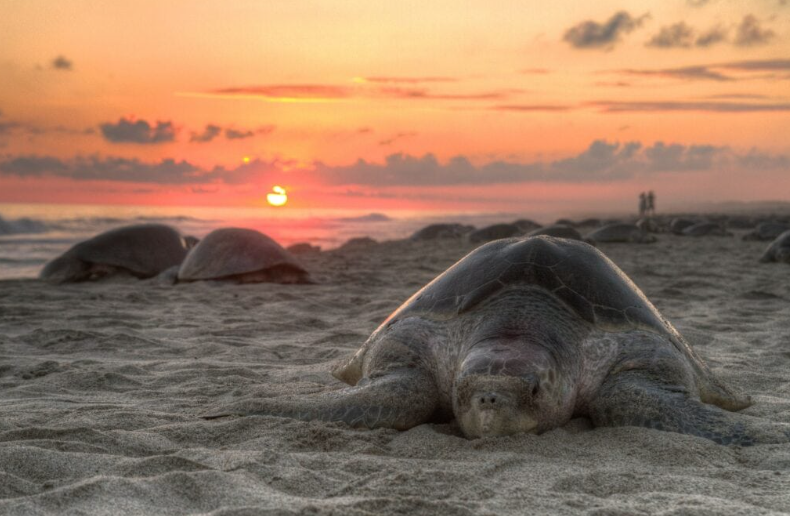
Every spring, as the Gulf of Mexico warms, one of nature’s most ancient rituals begins along the coast of Southwest Florida. Sea turtle nesting season is not merely a seasonal event but a critical biological window that sustains marine biodiversity and coastal health. From the white sands of Sarasota to the remote shores of Collier County, these gentle giants return to their natal beaches to ensure the survival of the next generation.
Dates and Key Nesting Locations
In Southwest Florida, the official sea turtle nesting season runs from May 1 through October 31. While the peak of nesting activity typically occurs in June and July, the first “emergences” can be recorded as early as late April, with hatching continuing well into the late autumn months (Collier County, 2024).
The region is home to some of the highest-density nesting areas for loggerhead (Caretta caretta) and green sea turtles (Chelonia mydas) in the United States (Fuentes et al., 2016). Key locations include:
- Sarasota County: Lido Key, Siesta Key, Casey Key, and Manasota Key.
- Collier County: Barefoot Beach, Vanderbilt Beach, Naples Beach, Marco Island, and the unbridged Keewaydin Island.
- Lee County: Sanibel and Captiva Islands, which have a long-standing history of dedicated conservation through the Sanibel-Captiva Conservation Foundation (SCCF).
How to Identify a Nest on the Beach
When you are walking the beach, look for the following “signs” of a protected nest:
- Stake and Tape: Most nests are marked with four yellow or neon wooden stakes and brightly colored surveyor’s tape.
- Signage: A “Sea Turtle Nest” warning sign is usually attached to the stakes, citing the Florida Marine Turtle Protection Act.
- Self-Releasing Screens: In areas with high predator activity (like raccoons), you may see a flat metal screen weighted down over the sand. These are designed to keep predators out while allowing hatchlings to crawl through the mesh.
Evolution of Conservation Labors
Conservation in Florida has shifted from a history of exploitation to one of rigorous scientific protection. In the 18th and 19th centuries, sea turtles were primarily viewed as a commercial resource for meat, oil, and shells (Wibbels & Bevan, 2016). The turning point arrived with the Endangered Species Act of 1973, which mandated the protection of these species and their habitats.
Over the decades, efforts have evolved in several key areas:
1. Habitat Restoration
Early efforts focused simply on counting nests, but modern conservation involves active habitat management. Research on Keewaydin Island has shown that removing invasive species like Australian pines (Casuarina equisetifolia) is vital. These pines shade the sand, lowering incubation temperatures and potentially skewing the sex ratios of hatchlings—which are temperature-dependent—toward a male-heavy population (Schmid et al., 2008).
2. Lighting Ordinances
One of the most significant advancements has been the implementation of “dark sky” policies. Hatchlings rely on the natural light of the horizon to find the sea. Artificial light causes “misorientation,” leading turtles toward dangerous roads or landward exhaustion. Modern regulations now require turtle-friendly “amber” or “long-wavelength” lighting, which is less disruptive to their navigation (Collier County, 2024).
3. Technological Monitoring
Organizations like Mote Marine Laboratory have monitored regional trends for over 40 years. Today, researchers use satellite telemetry and temperature data loggers to track migratory patterns and nest health, providing a data-rich look at population recovery (Lasala et al., 2023).
Ecological Importance: The Gardeners of the Sea
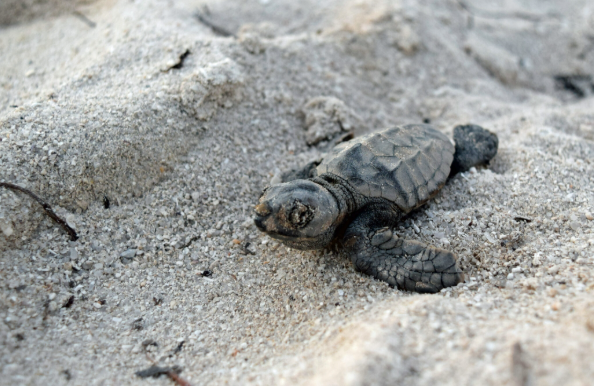
Sea turtles are “keystone species,” meaning their presence is a primary indicator of a healthy ecosystem. Their contributions are multifaceted:
- Nutrient Cycling: Sea turtles act as a bridge between the ocean and the land. Unhatched eggs and shells provide a concentrated source of nitrogen, phosphorus, and potassium to beach dunes. These nutrients allow dune vegetation to grow, which in turn stabilizes the shoreline against erosion (Fuentes et al., 2016).
- Seagrass Health: Green sea turtles are among the few animals that graze on seagrass. By “mowing” the beds, they prevent the grass from becoming overgrown and stagnant, which ensures the health of the entire seagrass community—a nursery for many commercial fish species.
- Reef Maintenance: Species like the hawksbill turtle forage on sponges. By keeping sponge populations in check, they prevent them from outcompeting coral for space, thereby maintaining the structural integrity of coral reefs.
Expert Perspectives
Experts at Mote Marine Laboratory, including researchers such as Jacob Lasala and Jerris Foote, emphasize that while nesting numbers have shown an encouraging upward trend over the last 40 years, human-driven threats remain.
“Anthropogenic threats remain highly present for sea turtles, and their protection on the beach is largely in the hands of individuals and regional agencies that can educate others on the issues that threaten their habitat.” (Ubry, 2023)
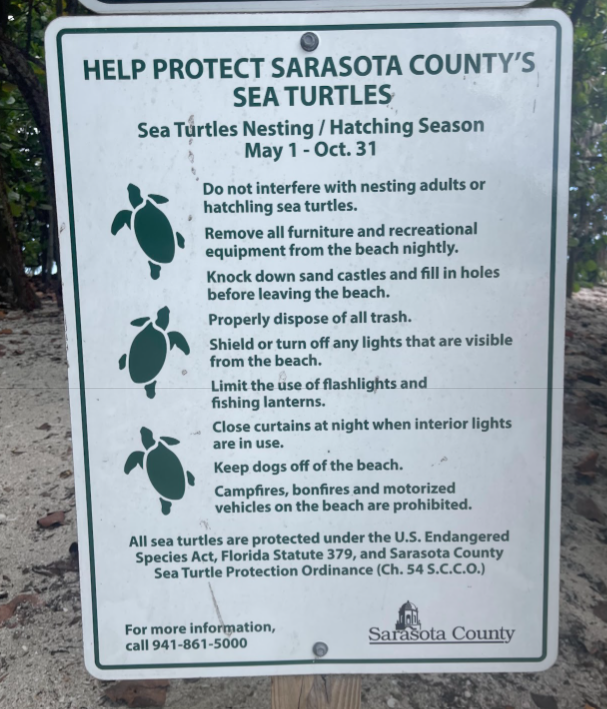
As Southwest Florida continues to develop, the balance between human recreation and wildlife preservation remains delicate. Residents and visitors are urged to keep beaches “dark, flat, and door-free” during the season—turning off lights, filling in holes in the sand, and removing furniture that might obstruct a nesting mother’s path.
References
Collier County. (2024). Collier County sea turtle protection plan annual report – 2024. Collier County Parks and Recreation. https://www.collierparks.com/wp-content/uploads/2025/05/2024-Sea-Turtle-Report.pdf
Fuentes, M. M. P. B., Gredzens, C., Bateman, B. L., Boettcher, R., Ceriani, S. A., Godfrey, M. H., Helmers, D., Ingram, D. K., Kamrowski, R. L., Pate, M., Pressey, R. L., & Radeloff, V. C. (2016). Conservation hotspots for marine turtle nesting in the United States based on coastal development. Ecological Applications, 26(8), 2708–2719. https://doi.org/10.1002/eap.1386 Cited by: 81
Lasala, J. A., Macksey, M. C., Mazzarella, K. T., Main, K. L., Foote, J. J., & Tucker, A. D. (2023). Forty years of monitoring increasing sea turtle relative abundance in the Gulf of Mexico. Scientific Reports, 13. https://doi.org/10.1038/s41598-023-43651-4 Cited by: 24
Schmid, J. L., Addison, D. S., Donnelly, M. A., Shirley, M. A., & Wibbels, T. (2008). The effect of Australian pine (Casuarina equisetifolia) removal on loggerhead sea turtle (Caretta caretta) incubation temperatures on Keewaydin Island, Florida. Journal of Coastal Research, 10055(2008), 214–220. https://doi.org/10.2112/si55-001.1 Cited by: 35
Wibbels, T., & Bevan, E. (2016). A historical perspective of the biology and conservation of the Kemp’s ridley sea turtle. Gulf of Mexico Science, 33(2). https://doi.org/10.18785/goms.3302.02
