

The 1763 Treaty of Paris was a geopolitical seismic event that shattered the existing order of North America. For the Gulf Coast, it wasn’t just a change of administration; it was a total demographic and political overhaul that birthed one of the most unique—and often forgotten—chapters in the American story: British West Florida.
1. The Great Geopolitical Swap: Florida for Havana
In 1763, the British Empire stood at its zenith after the Seven Years’ War. To secure the return of the strategically vital port of Havana (the “Pearl of the Antilles”), Spain agreed to a trade: they ceded the Florida peninsula and the Gulf Coast territories to the British.
Simultaneously, France surrendered its territories east of the Mississippi River (excluding New Orleans). The British, recognizing the vastness of this new wilderness, bisected the territory along the Apalachicola River to create two distinct colonies:
- East Florida (St. Augustine)
- West Florida (Pensacola).
The Boundary Shift: Extending the Reach
Initially, the northern boundary of West Florida was set at the 31st parallel. However, British authorities quickly realized that this line left out the fertile, high-ground settlements along the Mississippi River. In 1764, they shifted the border north to 32° 28’, encompassing the vital Natchez District and the Tombigbee District. This made West Florida a massive corridor of land stretching from the Mississippi River in the west to the Chattahoochee in the east.
2. A Frontier Restart: The Pensacola “Ghost Town”
When the first British Governor, George Johnstone, arrived in Pensacola in 1764, he didn’t find a bustling Spanish outpost. He found a near-total vacuum. Fearing life under British Protestant rule, virtually the entire Spanish population had evacuated to Cuba or Mexico.
The British inherited a town of decaying wooden huts and a dilapidated fort. They were essentially starting a colony from zero in a climate that was brutally humid, prone to hurricanes, and rife with “yellow fever.”
3. The Deerskin Empire: A Precarious Demographic
British West Florida was characterized by a staggering population imbalance. There were approximately ten Native Americans for every one European colonist.
The Creek and Choctaw Relationship
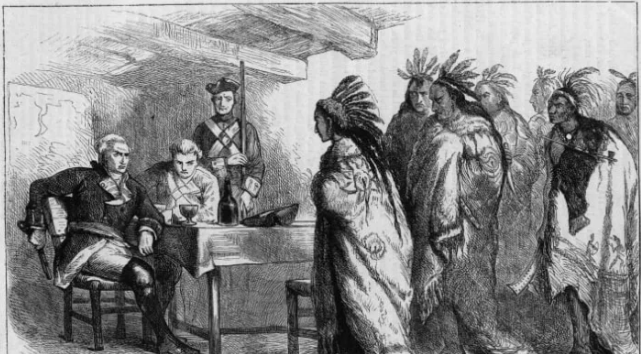
Unlike the northern colonies where land hunger led to constant warfare, West Florida’s survival depended on the Deerskin Trade. The British, led by Superintendent of Indian Affairs John Stuart, established a sophisticated trade network centered in Pensacola and Mobile.
- The Power of Trade: Native tribes (primarily the Creek and Choctaw) became inextricably linked to the British economy, trading deerskins for European goods like guns, iron kettles, and cloth.
- The Scottish Influence: Powerful Scottish merchant firms like Panton, Leslie & Co. established a near-monopoly on this trade, creating a commercial empire that would persist long after the British left.
4. The Economy: Blue Gold and Naval Stores
To make the colony profitable, the British leaned into the region’s natural resources.
- Indigo: Known as “Blue Gold,” indigo became the primary cash crop. In 1772 alone, the colony exported 15,000 pounds of the dye.
- Naval Stores: The dense pine forests of the Gulf Coast provided tar, pitch, and turpentine—essential materials for maintaining the Royal Navy, the backbone of British global power.
- Timber: Huge quantities of lumber were shipped to the Caribbean to support the sugar plantations of the West Indies.
5. The “14th Colony” and the Revolutionary Refusal
When the American Revolution ignited in 1775, the “Thirteen Colonies” hoped their neighbors to the south would join the rebellion. They were disappointed. British West Florida remained a staunch Loyalist stronghold for several key reasons:
- Isolation: They were geographically cut off from the radical politics of Boston and Philadelphia.
- Protection: The colonists feared the surrounding Native American nations and the Spanish in New Orleans more than they feared “taxation without representation.”
- The Loyalist Haven: As the war progressed, West Florida became a primary refuge for “Tories” fleeing the Carolinas and Georgia, seeking the safety of King George III’s promise of free land and military protection.
6. The Turning Point: The Willing Raid (1778)
The peace of West Florida was shattered by James Willing, a failed merchant-turned-Continental captain. In 1778, he led a “raid of plunder” down the Mississippi River aboard the armed boat Rattletrap.
Willing’s men seized plantations, looted properties, and forced settlers to sign oaths of neutrality. However, the raid was a strategic disaster for the Americans. Instead of winning hearts and minds, Willing’s brutality convinced the neutral settlers that they were safer under British rule, and it alerted the Spanish in New Orleans to the region’s vulnerability.
7. The Spanish Thunderbolt: Bernardo de Gálvez
In 1779, Spain officially entered the war against Great Britain. The Governor of Spanish Louisiana, the brilliant and daring Bernardo de Gálvez, saw an opportunity to reclaim the Gulf Coast.
Gálvez didn’t wait for the British to strike. He launched a lightning campaign:
- 1779: He captured British outposts at Baton Rouge and Natchez.
- 1780: He laid siege to and captured Fort Charlotte in Mobile.
The Siege of Pensacola (1781)
The climax of the campaign was the Siege of Pensacola. Gálvez arrived with a massive multi-national force of over 7,000 soldiers (including Spanish, French, and free Black militiamen).
For two months, the British at Fort George held out against a relentless bombardment. The end came on May 8, 1781, through a “lucky” (or divine, depending on the perspective) Spanish artillery shot. The shell struck the British powder magazine in an advanced redoubt, causing a massive explosion that killed over 100 British soldiers and blew a hole in the defenses. Two days later, the British surrendered the colony.
8. Legacy: The “West Florida Controversy”
The 1783 Treaty of Paris officially returned both Floridas to Spain. However, the British had left behind a mess. They had ceded the land to Spain using the 32° 28’ boundary, but they ceded the same land to the new United States using the 31st parallel.
This “border gap” would fuel decades of tension between the U.S. and Spain, eventually leading to the West Florida Rebellion of 1810 and the region’s eventual absorption into the United States. Today, the legacy of British West Florida lives on in the diverse cultural tapestry of Pensacola and the deep-rooted Scottish and Anglo influence that remains along the Gulf Coast.
Given the immense strategic importance of the deerskin trade and naval stores, do you think the American Revolution could have succeeded in the South if the Spanish hadn’t dismantled the British “safe haven” in West Florida?