Southwest Florida is one of the finest wildlife photography destinations in the United States. This is not regional boosterism — it is the considered opinion of professional wildlife photographers who have worked in Yellowstone, the Everglades, Alaska, and East Africa and still return to this corner of the Gulf Coast because the subjects are extraordinary, the light is generous, and the access is unlike almost anywhere else on the continent.
What makes Southwest Florida exceptional for wildlife photography specifically — as opposed to wildlife viewing generally — is a combination of factors that photographers need and that are rare to find together: habituated wildlife that tolerates close approach, predictable locations where subjects appear regularly, extraordinary light quality at dawn and dusk, intimate shooting distances that eliminate the need for extreme telephoto reach, and backgrounds of genuine visual beauty.
This guide covers the mechanics, locations, gear, and techniques that will help you come home with images worthy of the landscape.
Why Southwest Florida Is Exceptional for Photography
Habituated Wildlife
The wading birds and shorebirds that inhabit the managed natural areas of Southwest Florida — Ding Darling, Corkscrew Swamp, Six Mile Cypress Slough, and the Gulf beaches — have lived alongside humans for generations without being harassed. They have learned that people on boardwalks and parking areas are not predators, and they allow approach distances that would be impossible in wilderness areas where wildlife retains genuine fear of humans.
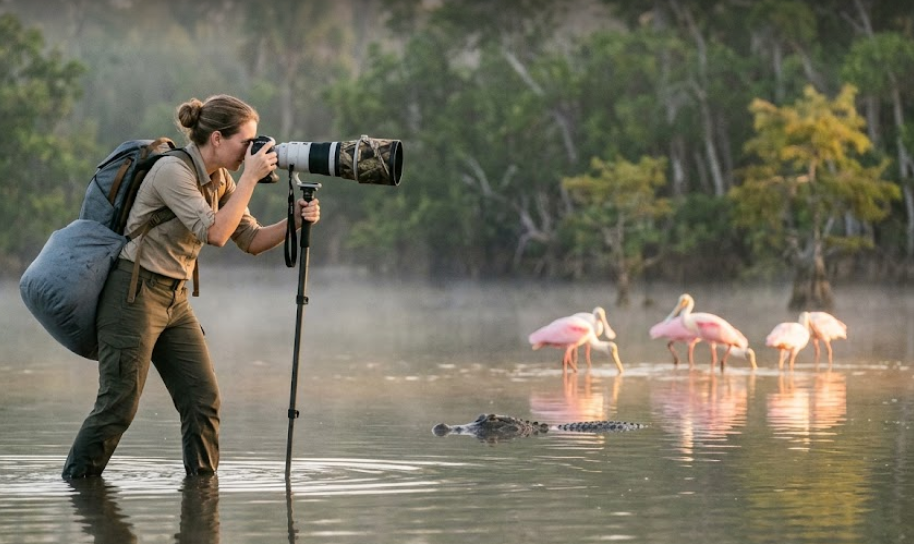
This habituation means that with patience and appropriate behavior, you can photograph a reddish egret dancing in the shallows, a barred owl perched at eye level on a cypress branch, or a roseate spoonbill feeding three meters from your lens — without a hide, without a vehicle blind, and without the specialized technique required for wild-flushing birds.
The Light
Southwest Florida light has a quality that professional photographers come for specifically. The flat topography means sunrise and sunset paint enormous unobstructed swaths of sky above open marsh and water. The golden hour here lasts longer and burns more intensely than in topographically complex landscapes. The haze that builds in humid air during midday is reversed at dawn, when the atmosphere is crystal clear and the low angle of light turns water surfaces into mirrors of gold and orange that make any subject photographed against them appear luminous.
The salt air and humidity also produce atmospheric effects — morning mist rising from warm water, cloud formations that build dramatically over the Gulf, rainbow-frequent afternoon downpours — that give landscape and wildlife photographs a depth and atmosphere that is specifically subtropical and specific to this region.
Subject Diversity
Within a single morning’s drive, a Southwest Florida photographer can photograph: wading birds in tidal flats at dawn, alligators basking in golden sidelight at a cypress slough, scrub-jays at close range in flatwood habitat, tarpon rolling in a backcountry river, dolphins surfacing in the intracoastal waterway, and roseate spoonbills glowing pink against a mangrove wall. The photographic variety is extraordinary.
Gear Recommendations
Cameras and Lenses
You do not need the most expensive camera system to make outstanding wildlife photographs in Southwest Florida. What you need is a camera with reasonably fast autofocus and a lens with enough focal length to fill the frame with your subject.
Minimum recommended: Any current mirrorless or DSLR body from Canon, Nikon, Sony, or Fujifilm, paired with a 100–400mm or 150–600mm zoom lens. This covers 90% of the wildlife photography situations you’ll encounter here.
Ideal for wading birds: A 500mm or 600mm prime lens provides maximum subject isolation and background blur for portraits, but many of the region’s best wildlife images have been made with zoom lenses in the 400–600mm range.
For habituated boardwalk subjects: The barred owls at Corkscrew and the herons at Six Mile Cypress Slough allow such close approach that a 300mm lens — or even a 70–200mm in tight quarters on a narrow boardwalk — is sometimes more appropriate than longer glass.
Wide angle for context: Don’t neglect a wide-angle lens (16–35mm or 24–70mm). The best wildlife photographs are often environmental portraits that show an animal in its habitat rather than frame-filling close-ups. A roseate spoonbill against a sunrise sky over a vast marsh, rendered at 24mm, can be more powerful than a frame-filling portrait.
Tripod vs. Monopod vs. Handheld
Many Southwest Florida shooting situations — boardwalks, roadside birds, beach subjects — support handheld shooting with adequate light and modern image stabilization. For low-light dawn and dusk shooting with long lenses, a monopod provides meaningful stabilization without the bulk of a full tripod. A full tripod with a gimbal head is the professional standard for serious long-lens work but is overkill for casual photography at most accessible sites.
For kayak-based photography, a beanbag resting on the kayak’s bow is the most practical support option — it stabilizes the lens without the rigidity of a tripod and can be repositioned instantly as the subject moves.
Weather and Humidity
Southwest Florida’s humidity is genuine. Camera gear in a cold air-conditioned car moved into warm, humid outdoor air will immediately fog — give equipment 10–15 minutes to acclimate before shooting. For extended field use, silica gel desiccant packets stored with equipment reduce internal lens fogging. A rain cover or large zip-lock bag for emergency downpours is worth carrying.
Sensor dust is more common here than in dry climates — bring a sensor cleaning kit and clean frequently.
Key Photography Locations by Subject
Wading Birds — Best Locations
Ding Darling NWR, Sanibel (Lee County) The tidal flats exposed along the Wildlife Drive at low tide are the finest wading bird photography location in the region. Reddish egrets perform their spread-wing “canopy feeding” behavior here in full view, tricolored herons probe the shallows at close range, and roseate spoonbills feed in the shallow water against backgrounds of mangrove green and Gulf sky. The light on the west side of the drive is best in morning. Arrive at opening (sunrise) and walk or drive slowly — the first pass yields the best behavior before midday heat reduces activity.
Six Mile Cypress Slough, Fort Myers (Lee County) The elevated boardwalk creates a shooting platform at mid-canopy height, producing eye-level images of nesting herons and anhingas that would be impossible from ground level. January–April, the nesting colonies in the cypress canopy are active at close range from the boardwalk — large herons and anhingas building nests, exchanging greeting displays, and caring for chicks in natural-light conditions that produce excellent photographs even in challenging midday light.
Corkscrew Swamp Sanctuary (Collier County) The boardwalk’s proximity to the wood stork nesting colony in the old-growth cypress is extraordinary for nesting behavior photography. The barred owls here are so accustomed to boardwalk visitors that close-portrait opportunities arise regularly. Limpkins along the boardwalk edge allow intimate habitat portraits.
Alligators — Best Locations
Big Cypress National Preserve — Loop Road Alligators in Big Cypress bask on road surfaces during cool morning hours (November–March), allowing vehicle-blind photography at extremely close range. Driving Loop Road slowly on a cool morning and watching for road-basking alligators produces full-sun sidelight conditions in early morning that make powerful graphic images. Maintain engine-off, window-down technique and allow the alligators to ignore your presence.
Myakka River State Park (Sarasota County) The deep concentration of alligators at the Myakka Lake boat basin in dry season — when dozens of individuals aggregate on the bank and in the shallows — provides exceptional photography with natural backgrounds.
Oasis Visitor Center canal, Big Cypress Perhaps the single most accessible alligator photography in the state. The canal directly behind the visitor center regularly holds 20–40 alligators at close range, in good light conditions, with a variety of natural behaviors including thermoregulating, swimming, and occasional interactions between individuals.
Dolphins — Best Locations
Gordon Pass and Naples Bay Bottlenose dolphins regularly work the Gordon Pass inlet and adjacent bay on the incoming tide, chasing mullet toward shore. Early morning boat traffic is minimal. From the north jetty at Gordon Pass (accessible by foot from Lowdermilk Park), dolphins frequently pass within 15–30 meters of shore — telephoto portraits and action sequences are possible without a boat.
Wiggins Pass State Park Similar inlet dynamics, with dolphin groups hunting mullet and sheepshead through the pass on tide changes. The boardwalk approach allows stable shooting positions.
Florida Scrub-Jay — Best Locations
Oscar Scherer State Park (Sarasota County) Florida scrub-jays are extraordinarily confiding — they are known for landing on people’s heads and hands in scrub habitat where they’ve been habituated to humans. Oscar Scherer has one of the most accessible scrub-jay populations in the state, making it the best location in the region for close-portrait and behavioral photography of this charismatic endemic species.
Myakka River State Park (Sarasota County) A secondary location with a reliable resident family in the scrub sections of the park’s north end.
Roseate Spoonbills — Best Locations
(Covered in depth in the dedicated spoonbill article — see “Where to See Roseate Spoonbills in SWFL”)
Key quick reference: Ding Darling NWR (year-round, peak Oct–March), Tigertail Beach on Marco Island (Oct–April), Corkscrew Swamp wet prairie (seasonal), and the T.M. Goodlette-Frank Road rookery in Naples (active nesting colony, peak February–April).
Technique: Getting the Shot
Approaching Wildlife
The most important technique in Southwest Florida wildlife photography is slow, nonthreatening approach. Move toward a subject at a pace that allows it to register your presence and evaluate your threat level. Stop when the animal shows awareness — a head lift, a posture change, a slight repositioning away from you. Wait. If the animal returns to its previous behavior, your presence has been accepted. Continue approaching slowly if the distance still requires it.
The approach angle matters. Coming directly at a subject from the front is more alarming than a slow oblique approach from the side. In shallow tidal water, moving parallel to a feeding bird before gradually closing the distance is far more effective than direct frontal approach.
The golden rule: The shot is never worth flushing the bird or disturbing the animal. An animal that flushes or retreats because of your approach is an animal that other photographers and observers will find absent. Practice the discipline of taking the shot at a comfortable distance and moving closer only if the animal’s behavior clearly accepts your presence.
Working the Light
Dawn: Arrive at your location before sunrise. The first 30 minutes after the sun clears the horizon are typically the best — warm, directional light at low angle, atmospheric clarity, and maximum wildlife activity. Plan your position relative to the sun’s direction the night before.
The “magic hour” math: In Southwest Florida, true golden light lasts approximately 45–60 minutes after sunrise and before sunset. Midday light (10 AM–3 PM) is harsh, directional, and produces unflattering shadows — use midday for scouting and location research rather than serious shooting.
Overcast light: An even, diffuse overcast sky functions as an enormous soft box and is excellent for detail and color work — particularly with subjects that are strongly patterned (snakes, owls, waders with complex plumage). Don’t stay home because it’s cloudy.
Backgrounds and Composition
Southwest Florida’s backgrounds deserve as much attention as the subject. The region’s most visually powerful wildlife images use the environment deliberately: a spoonbill reflected in mirror-calm water, an alligator silhouetted against a sunrise sky, a barred owl with old-growth cypress bokeh behind it.
Shallow depth of field (wide aperture, long focal length, subject close to lens) produces the subject-isolation images that characterize professional wildlife photography. Aperture priority mode at f/5.6–f/8 on a 400mm+ lens with the subject at 5–15 meters creates the smooth, out-of-focus backgrounds that eliminate distracting vegetation and water elements.
Environmental context — deliberately shooting wider to include habitat — tells a story and produces images with a sense of place that tight portraits don’t. A reddish egret at 100% frame fill is a good shot; a reddish egret at 20% frame fill with a hundred acres of Ding Darling tidal flat glowing at sunrise is an extraordinary one.
Ethics in Wildlife Photography
Southwest Florida’s wildlife is habituated because it has been treated respectfully for generations. Maintaining that trust — and the photography opportunities that come from it — requires every photographer to behave with the animal’s wellbeing as the primary consideration.
Never approach active nests at close range. Disturbance at active nests causes adults to flush, exposing eggs and chicks to heat and predation. The wood stork colony at Corkscrew has suffered significant nest failure in years when visitor pressure was excessive. Photograph nesting activity from the boardwalk distance only.
Never use playback calls to attract birds during nesting season (approximately March–August). Call playback can interfere with territory establishment and breeding behavior. Use it sparingly if at all, and never repeatedly at the same location.
Never bait wildlife. Feeding alligators, birds, or mammals is illegal, potentially fatal to the animals (habituated wildlife that approaches humans for food must often be euthanized), and produces fundamentally dishonest photographs. If the image required bait, it’s not a wildlife photograph — it’s a studio shot in an outdoor set.
Leave habitat as found. Don’t move branches, break vegetation, or clear backgrounds to improve an image. The habitat is the subject’s home.
Photography Communities and Resources
Florida Wildlife Photographers Facebook Group — Active regional community with regular location sharing and critique.
Naples Audubon Society — Organizes guided birding and photography field trips, year-round.
Corkscrew Swamp Sanctuary Photography Workshops — Seasonal programs led by working photographers in an exceptional setting.
eBird (Cornell Lab) — Real-time sighting data that functions as a location scout for wildlife photographers. Check what’s being seen at any preserve before driving there.
Southwest Florida rewards patient, ethical, and prepared photographers with images that require no embellishment and no exotic travel. The landscape and its wildlife are doing everything. Your job is simply to show up, slow down, and pay attention.