

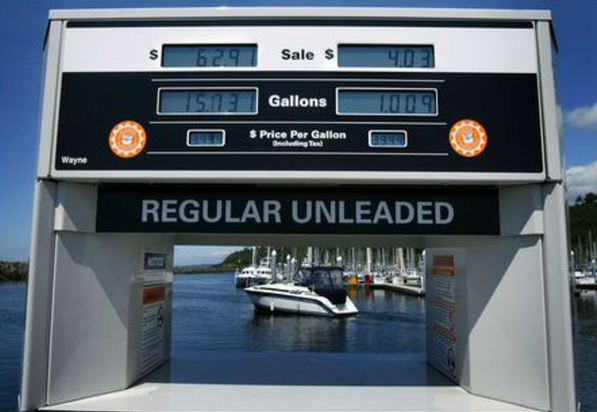
For decades, the rhythmic hum of outboard engines has served as the unofficial heartbeat of Southwest Florida. From the sprawling seagrass beds of Sarasota Bay to the deep-water passes of Naples, the boating industry is more than a pastime—it is a multi-billion dollar economic engine. However, as of April 2026, that engine is beginning to sputter.
The recent “Hormuz Spike,” which sent global oil prices soaring, has hit the marine sector with surgical precision. In a region where the “commute” often involves a 50-mile run to the offshore ledges, the leap in fuel costs is transforming the landscape of recreation, commerce, and conservation.
1. The Marina Perspective: A New Reality at the Pump
Marinas from Palmetto to Marco Island are finding themselves in the unenviable position of being the “bearers of bad news.” Unlike land-based gas stations, marine fuel docks face higher overhead due to specialized storage, environmental compliance, and the logistics of delivering to waterfront locations.
At high-traffic hubs like Marina Jack in Sarasota and The Boat House in Cape Coral, the price for 90-octane non-ethanol fuel—the gold standard for marine engines—has stabilized at a painful $5.85 to $6.20 per gallon. Marine diesel, essential for the larger yachts and commercial trawlers, has seen even more volatility, occasionally peaking at $6.75 in remote locations like Cabbage Key.
“It’s a ghost town on Tuesdays,” says Dave McAlister, a veteran dockmaster in Charlotte County. “Usually, we’d have a steady stream of locals topping off mid-week. Now, people are watching the futures market like they’re day traders before they decide to drop $400 in their tanks.”
2. Recreational Boating: The Rise of “Sandbar Culture”
For the recreational boater, the reaction to high fuel costs has been a dramatic shift in navigation patterns. The days of “running for the sake of running” are largely over.
The Short-Range Shift
Instead of making the trek from Sarasota down to Boca Grande for lunch, boaters are staying local. This has led to record-breaking crowds at proximal “party spots” like:
- Jewfish Key (Longboat Pass)
- Snake Island (Venice)
- Beer Can Island (North Longboat Key)
- Keewaydin Island (Naples)
The environmental impact of this concentration is a growing concern for local conservationists, as heavy traffic in limited areas puts immense pressure on local seagrasses and manatee corridors.
The Maintenance Domino Effect
There is also a hidden danger in these rising costs: the “maintenance deferral.” When a weekend outing costs $150 more in fuel than it did last year, boaters often look for savings elsewhere. Local mechanics in Bradenton report a 20% increase in service cancellations. “People are skipping their 100-hour service to pay for the gas,” warns one technician. “In the long run, that’s a recipe for a $15,000 engine failure.”
3. The Charter Industry: A Surcharge Summer
The charter fishing and eco-tour industry in Southwest Florida is the front line of this economic battle. Operators in Fort Myers Beach and Sanibel, still recovering from the long-term infrastructure rebuilds of the mid-2020s, are now facing an “operational tax” they cannot ignore.
The Math of a Fishing Trip
A typical offshore charter targeting grouper or snapper 40 miles out might burn 100 to 120 gallons.
- April 2025 Cost: ~$450.00
- April 2026 Cost: ~$720.00
“I can’t just raise my base rate by $300 overnight; I’d lose my repeat clients,” explains Capt. Steve “Salty” Miller, who operates out of Siesta Key. “Most of us have moved to a floating fuel surcharge. It’s transparent—the client sees the pump price, and we add the difference. Most people understand, but it definitely impacts the tips, which is how my mates make their living.”
4. The Commercial Fleet: Breaking the Back of “Pink Gold”
While recreational boaters are inconvenienced, the commercial fleet is in an existential crisis. The shrimping industry in Fort Myers Beach, world-renowned for “Florida Pinks,” is perhaps the hardest hit.
A single shrimping trawler can require 10,000 gallons of diesel for a month-long trip in the Gulf. A $2.00 per gallon increase represents a $20,000 surge in overhead per boat. With the price of imported shrimp remaining low due to international subsidies, local fishermen are being squeezed from both sides.
“We’re seeing boats tied up at the docks that haven’t missed a season in thirty years,” says Mary Henderson, a third-generation seafood wholesaler in Pine Island. “It’s not just the fuel; it’s the ice, the nets, and the labor. But the fuel is the trigger. If you aren’t 100% sure the catch will cover the diesel, you don’t untie the lines. It’s that simple.”
5. Long-Term Impacts: A Structural Transformation
The “Hormuz Spike” of 2026 may be remembered as the catalyst that ended the era of “brute force” boating in Florida. The industry is already beginning to pivot in three distinct ways:
A. The “Great Downsizing”
The market for massive, quad-engine center consoles—the “SUVs of the sea”—is cooling rapidly. In their place, there is a renewed interest in:
- Single-engine bay boats: Offering 4–5 miles per gallon compared to 0.8 mpg for larger vessels.
- Hybrid Propulsion: While still in its infancy, manufacturers like Intrepid and Boston Whaler are seeing increased inquiries into electric-assist and high-efficiency hull designs.
B. Fractional Ownership and Clubs
As the “cost per hour” of boat ownership rises, boat clubs like Freedom Boat Club are seeing a surge in memberships. By spreading the fixed costs and fuel logistics across a larger pool of members, the “shared economy” model is becoming the only viable way for many middle-class families to stay on the water.
C. Infrastructure and Real Estate
Waterfront restaurants in Matlacha and Venice that rely on “boat-in” traffic are reporting a shift in demographics. The “boater-lunch” crowd is being replaced by car traffic as people choose to drive to the restaurant rather than spend $80 in fuel for a $60 lunch. Long-term, this could lead to a decline in the premium placed on “dock-and-dine” facilities.
Conclusion
The waters of Southwest Florida remain as beautiful as ever, but the cost of traversing them has reached a historic tipping point. While the “Hormuz Spike” may eventually level off, the lessons learned during this period of high volatility are likely to stick. The future of Florida boating is being written today—and it is a future defined by efficiency, proximity, and a much deeper respect for the price of every knot.