
For saltwater anglers, the lunar cycle is more than just a calendar—it’s a tide chart, a feeding schedule, and often a spawning indicator. While other factors like weather, water temperature, and bait presence are critical, the gravitational influence of the moon is the primary driver of tidal movement, which directly impacts fish behavior.
New Moon and Full Moon: The Spring Tide Advantage
The most predictable and generally best times for fishing in Southwest Florida are around the New Moon and the Full Moon.
- Tidal Extremes (Spring Tides): When the sun, moon, and earth align (at both New and Full Moons), their gravitational pull is compounded. This results in the highest high tides and the lowest low tides, known as spring tides (not related to the season).
- Increased Current Flow: These extreme tides create the heaviest current flow, which is key to stimulating fish activity. Strong currents dislodge baitfish and crustaceans, forcing predators to feed actively.
- The Daytime Bite (New Moon): With less moonlight at night, fish like snook, redfish, and trout are often more active during the day around the New Moon, especially during the major and minor Solunar periods (moonrise/moonset and moon overhead/underfoot).
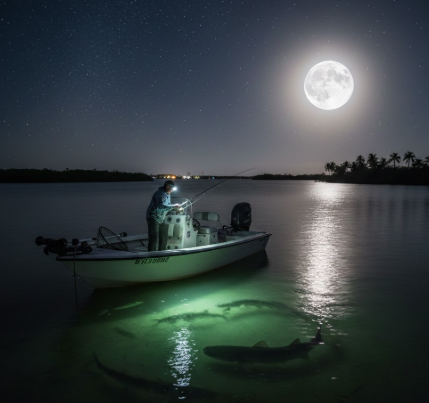
- The Nighttime Bite (Full Moon): The bright light of the Full Moon can trigger intense nocturnal feeding, especially for predatory species. Anglers targeting snook and tarpon often find night fishing highly productive. However, this heavy night feeding can sometimes lead to a slower daytime bite immediately following the full moon, as fish are already full.
- Spawning and Migration: Many inshore and offshore species, notably tarpon during their spring and summer runs, time their spawning activity with the high current flow of the New and Full Moon cycles to widely disperse their eggs. The famous “hill tides” in areas like Boca Grande Pass, where crabs are flushed out, coincide with these strong lunar tides, creating a feast for massive tarpon.
Quarter Moons: The Neap Tide Challenge

About a week after the Full and New Moons, the First and Last Quarter Moons occur.
- Weaker Tides (Neap Tides): During the Quarter Moons, the gravitational pulls of the sun and moon are at right angles, partially canceling each other out. This results in neap tides, where the tidal fluctuation is less extreme.
- Slower Fishing: The reduced current flow means bait isn’t being moved around as aggressively, which can lead to a less predictable or slower bite. Fish don’t need to expend as much energy to hold a position in the current, and their feeding may be more spread out.
- Focus on Structure and Time: On neap tides, it becomes even more crucial to target areas with natural current funnels, like deep holes, points, and channel edges. Pay close attention to the Solunar feeding periods—the brief windows around moonrise, moonset, moon-up, and moon-down—as these may represent the only times of significant activity.
Solunar Periods: Maximizing Your Windows
Beyond the major phases, the Solunar Theory helps pinpoint the most active feeding times within any given day, regardless of the moon phase.
- Major Periods: Occur when the moon is directly overhead (moon-up) or directly underfoot (moon-down).
- Minor Periods: Occur during moonrise and moonset.
For the Southwest Florida fisherman, lining up a major Solunar period with a strong tidal movement (New or Full Moon) or with sunrise/sunset can be the difference between a slow day and an epic trip. Even during weaker tidal phases, fishing the 45 minutes before and after a Solunar period can significantly boost your success.
The Moon’s phases primarily affect the fishing bite by regulating the strength of the tidal current, which dictates when and where the fish feed.
Check out this video to hear a captain’s take on how the Full Moon compares to the New Moon for fishing: Full Moon vs. New Moon Fishing | Captain Dylan Hubbard Explains the Best Times to Fish.