
If you’ve lived in Florida for more than a few months, you’ve likely experienced the biannual “splat” on your windshield that signals the arrival of the lovebug. These tiny, conjoined hitchhikers are a hallmark of the Sunshine State, appearing in clouds so thick they can transform a white car into a black-speckled mess in a single highway trip.
Despite their constant presence, they remain one of Florida’s most misunderstood residents. Here is a look at what these insects actually are, where they go when they aren’t covering your bumper, and the truth behind their origin.
What Are Lovebugs?
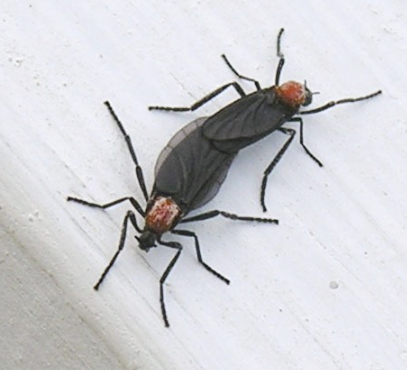
The lovebug (Plecia nearctica) is not actually a bug—it’s a species of march fly. They are small, black insects distinguished by a bright red or orange “cape” on their thorax (the section just behind the head).
Their name comes from their distinctive mating behavior. You rarely see a lovebug alone; instead, they are almost always found as a pair, joined tail-to-tail. They can remain in this “romantic” embrace for several days, even while flying. Interestingly, they don’t bite, sting, or carry diseases. Their primary goal as adults is simple: find a partner, mate, and lay eggs.
The “University of Florida” Myth
One of Florida’s most persistent urban legends is that lovebugs were a “science experiment gone wrong” created by the University of Florida (UF) to control the mosquito population.
The reality: * They don’t eat mosquitoes: Adult lovebugs feed primarily on nectar.
- They weren’t “made”: They are a naturally occurring species that migrated to Florida on their own.
- The Timeline: Lovebugs were documented in the Florida Panhandle as early as 1947, long before the genetic engineering capabilities rumored in the myth even existed.
The Two Seasons: April and September
Lovebugs don’t stick around all year. Instead, they emerge in massive “flights” that last for about four to five weeks, twice a year:
- The Spring Flight: Late April into May.
- The Fall Flight: Late August into September.
They are most active during the day, specifically between 10 a.m. and 6 p.m., and they are famously attracted to heat and car exhaust. This is why they tend to congregate over highways—the hot pavement and the chemical compounds in exhaust fumes act as a magnet for swarms.
The Invisible Off-Season
A common question is: Where do they go for the other 10 months of the year? They don’t migrate away; they simply change form. For the vast majority of their lives, lovebugs live in the soil as larvae.
- Where they hide: After mating, the female lays her eggs (up to 600 at a time) in moist soil, specifically under decaying vegetation, lawn clippings, or thatch.
- What they do: The larvae act as nature’s recyclers. They spend months hidden in the ground, eating dead grass and decomposing plant matter, which helps return nutrients to the soil.
- The Transformation: Once they’ve grown sufficiently, they enter a pupal stage before emerging as the flying adults we see during “season.”
Where Else Do They Live?
While often associated with Florida, lovebugs are not exclusive to the state. They are native to Central America and Mexico.
Over the last century, they have gradually expanded their range northward and eastward along the Gulf Coast. Today, you can find them in:
- The Gulf States: Texas, Louisiana, Mississippi, and Alabama.
- The Southeast: Georgia, South Carolina, and as far north as North Carolina.
Quick Tips for “Lovebug Management”
- Wax Your Car: A fresh coat of wax makes it harder for the bugs to stick and easier to wash them off.
- Don’t Wait to Wash: Lovebug remains are highly acidic. If left in the hot Florida sun for more than 48 hours, they can permanently etch the paint on your vehicle.
- Drive at Night: If you’re planning a long road trip, driving after sunset or before dawn can help you avoid the peak swarming hours.
- Use Fans: Lovebugs are weak fliers. If you are trying to enjoy a patio or porch, a high-speed fan is usually enough to keep them from landing.

3 comments
View explicit videos securely on reputable adult platforms.
Find trusted sites for a premium experience.
Also visit my web page … full porn movies
Новейшие сайты для взрослых предлагают инновационный контент для развлечений для взрослых.
Откройте для себя безопасные новые платформы для современного опыта.
Take a look at my web page … xnxxxxxxxx
Wow! This platform is absolutely top-notch! The
selection of tranny porn videos is massive – tons of sexy trans
girls in premium scenes. The streaming is fast and flawless and new content
are added frequently.
If you’re looking to watch shemale porn videos featuring hot performers and raw action, this is without
a doubt the best spot. Totally recommended!