Southwest Florida is world-renowned among paleontologists, beachcombers, and adventure travelers as the premier fossil-hunting region in North America. Stretched along the Gulf of Mexico in Sarasota and Charlotte counties—and reaching inland along the Peace River—this region rests atop rich prehistoric deposits. Millions of years ago, during the Miocene and Pliocene epochs, prehistoric sharks, marine mammals, and ice-age megafauna thrived here. Today, their fossilized remains wash ashore on quartz-sand beaches or rest submerged in river beds and ocean ledges.
Whether you are a casual collector seeking small black tiger teeth along the surf line or a scuba diver searching for 6-inch Megalodon crowns, this guide covers every major hunting location, seasonal strategy, gear requirement, and insider technique in Southwest Florida.
1. The Capital of Fossils: Venice Beach & The Bone Valley Formation
Known globally as the “Shark Tooth Capital of the World,” Venice, Florida, owes its rich fossil abundance to the coastal Hawthorn Group and the Bone Valley Formation. Between 2 to 20 million years ago, the Florida peninsula was submerged under a shallow, warm tropical sea teeming with prehistoric sea life—including the massive Otodus megalodon, giant snaggletooth sharks (Hemipristis serra), prehistoric whale species, and ancient dugongs.
As sea levels fluctuated and ancient rivers carved through prehistoric strata, millions of shedding teeth and bones accumulated in river basins and offshore ledges. Today, coastal wave action continually erodes these sub-surface fossil beds, pushing thousands of fossilized teeth onto the shores daily.
2. Best Shark Tooth Beaches in Southwest Florida, Ranked
While shark teeth can be found along much of Florida’s Suncoast, specific beaches feature natural wave dynamics and offshore geology that concentrate fossils in high quantities.
| Rank | Beach Location | Primary Fossil Types | Ease of Access | Best For |
| #1 | Caspersen Beach (Venice) | Small to large shark teeth, ray plates, bone fragments | Moderate (rocky entry in areas) | High-volume hunting, natural scenery |
| #2 | Stump Pass Beach State Park (Manasota Key) | High-density small teeth, lemon, bull, & sand tiger teeth | Moderate (10-15 min walk from parking) | Beating crowds, quantity over size |
| #3 | Venice Beach & Fishing Pier / Service Club Park | Lemon, tiger, snaggletooth, occasional Megalodon pieces | Easy (paved parking, boardwalks) | Families, first-timers, comfortable amenities |
| #4 | Manasota Key / Blind Pass Beach | Snaggletooth, sand tiger, ray teeth, dark coquina gravel | Easy to Moderate | Relaxed beach days, peaceful hunting |
| #5 | Englewood Beach & Chadbourne Park | Small shark teeth, shell beds, soft wave wash | Easy | Shallow wading, relaxed beach combing |
| #6 | Casey Key & Nokomis Beach | Scattered small shark teeth, fossilized shell casts | Easy | Combining shelling with casual tooth hunting |
3. Caspersen Beach: Florida’s Premier Fossil Beach
Described as the ultimate “shark tooth beach in Florida,” Caspersen Beach (located at the southern end of Venice) is the region’s undisputed crown jewel for land-based fossil hunting.
What Makes Caspersen Unique?
Unlike the soft white sand beaches farther north, Caspersen features exposed dark coquina rock formations, deep wave trenches, and dense bands of black phosphate gravel along the tide line. Waves roll over offshore ledges, carrying fossils directly into these natural gravel traps.
Where and How to Hunt at Caspersen
- The Shoreline Gravel Bands: Walk along the wet sand at the lowest point of the tide line. Look for bands where dark shell fragments, coquina rock, and black gravel accumulate.
- Southward Trail: Walk south past the paved park facilities along the unpaved trail. The further south you walk toward the natural coastal hammocks, the less foot traffic you encounter.
- Tide Pools & Exposed Rocks: Wade waist-deep during low tide near the submerged coquina shelves. Use a sifter to scoop gravel out of the hollows behind the rock formations.
4. Manasota Key, Stump Pass, & Englewood Beach Guides
Moving south from Venice along Manasota Key reveals several outstanding, highly productive beaches that see fewer crowds.
Manasota Key & Blind Pass Beach (Middle Beach)
Blind Pass Beach features deep offshore troughs where wave energy dumps fossilized material onto dark sand beds.
- What to Find: Abundant snaggletooth (Hemipristis serra) teeth, tiger shark teeth, and fossilized stingray mouth plates.
- Local’s Tip: Target the shore break right where the waves crash onto the sloping sand. The backwash briefly exposes heavy black teeth before they sink back into the sand.
Stump Pass Beach State Park: The High-Yield Secret
Located at the southernmost tip of Manasota Key, Stump Pass Beach produces high volumes of small shark teeth daily. Because tidal currents sweep rapidly through the pass between Manasota Key and Knight Island, thousands of micro-fossils are deposited along the spit.
- The Strategy: Pay the state park entrance fee, park near the trailhead, and hike south down the narrow barrier island tip.
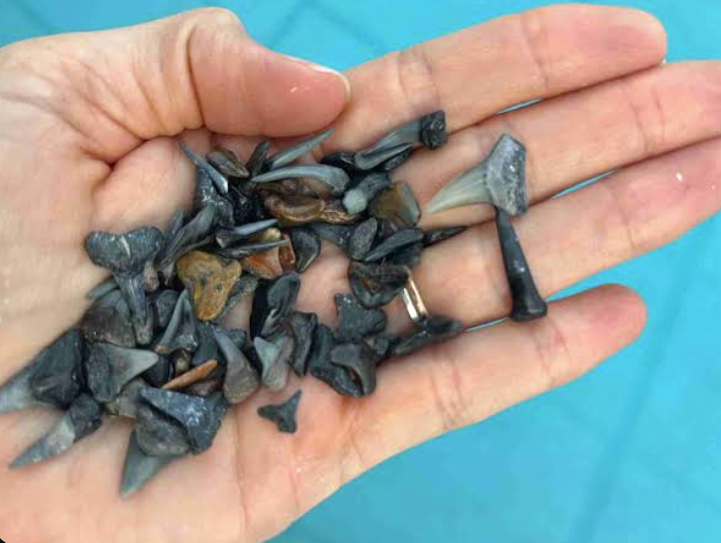
- What to Expect: Millions of small 1/4-inch to 3/4-inch teeth (lemon, dusky, sand tiger, and puppy-tooth tiger sharks). It is ideal for scoop sifters.
Englewood Beach (Chadwick Park)
Located just north of Stump Pass, Englewood Beach is wide and accessible with soft sand slopes.
- Best Time to Go: Winter cold fronts (December through March) or immediately following summer afternoon thunderstorms when Gulf swells churn up the seabed.
5. Inland River Expedition: Fossil Hunting on the Peace River
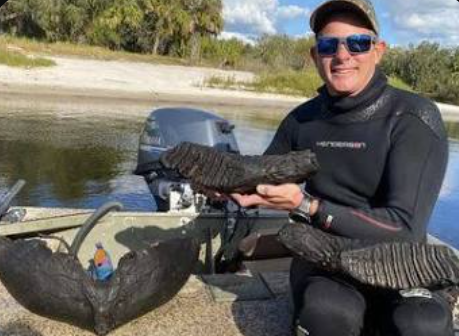
For collectors seeking larger specimens—including whole 3 to 5-inch Megalodon teeth, mammoth molars, and ice-age mammal bones—the Peace River near Arcadia, Florida, is an iconic freshwater destination.
Key Peace River Locations & Access Points
- Gardner Boat Ramp (Gardner, FL): Premier access point for wading or launching a canoe/kayak. Upstream and downstream gravel bars yield high concentrations of fossils.
- Brownville Park (Arcadia, FL): Excellent boat launch with camping facilities and deep river beds rich in vertebrate fossils.
- Pioneer Park (Zolfo Springs, FL): Good northern access point during low-water conditions.
Essential Peace River Regulations: Florida Fossil Permit
- Shark Teeth & Invertebrates: No permit required. Anyone can legally collect fossil shark teeth, stingray barbs, and invertebrate shells from Florida water bodies.
- Vertebrate Fossils (Mammal/Reptile Bones): Permit Required. Collecting land mammal fossils (mammoth teeth, horse teeth, tapir jaw, camel bones, dugong ribs) requires a Florida Fossil Permit issued by the Florida Museum of Natural History ($5 per year).
Best Season for the Peace River
- Dry Season (November to May): Optimal. River levels drop to 1–3 feet, exposing gravel bars and allowing walk-in wading and sifting.
- Wet Season (June to October): Avoid. Summer rains raise river levels above 6 feet, making sifting dangerous and ineffective due to fast currents and low visibility.
6. Offshore Shark Tooth Diving in Venice: Deep Water Megalodons
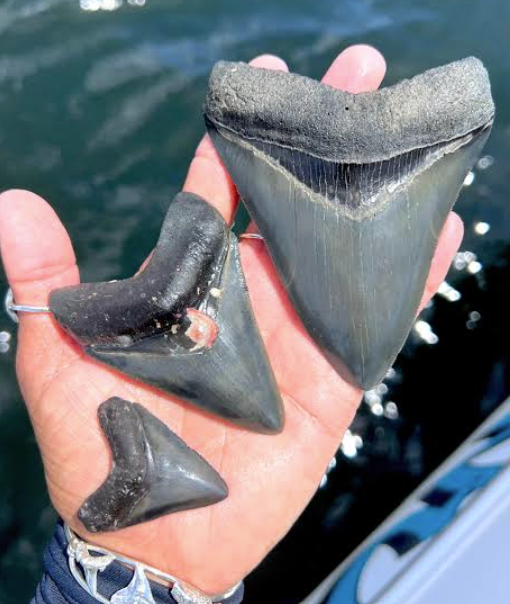
While beachcombing yields thousands of smaller teeth, finding a pristine, unbroken 5-inch or 6-inch Megalodon tooth usually requires going offshore with SCUBA gear.
How Offshore Fossil Diving Works
- The Location: Charter boats run 1 to 3 miles off the coast of Venice to the Venice Ledge or “Megalodon Ledge.”
- Depth & Visibility: Depths range from 15 to 35 feet. Visibility ranges from 3 feet on murky days up to 15+ feet on calm summer days.
- The Method: Divers carry heavy dive weights, mesh catch bags, and small trowels or three-prong cultivators. Divers crawl along the ocean floor, searching dark gravel pockets, clay exposures, and sandy depressions between coquina ridges.
- The Target: Giant Otodus megalodon teeth, prehistoric whale vertebrae, mastodon molars, and giant white shark (Carcharodon carcharias) teeth with complete enamel and root structures.
7. Best Sifters & Tools for SWFL Fossil Hunting
Having the right gear makes a dramatic difference in your fossil yield.
Gear Guide Overview
1. The Venice Rake (Florida Snow Shovel)
- Design: A wire mesh basket mounted on a long wooden or aluminum handle with a angled front lip.
- Best For: Standing in knee-deep to waist-deep surf and scooping heavy gravel without bending over.
- Pros: Saves your back; highly durable in saltwater surf.
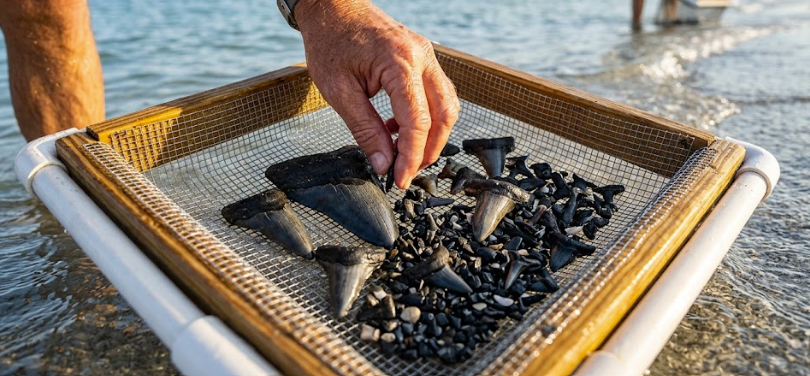
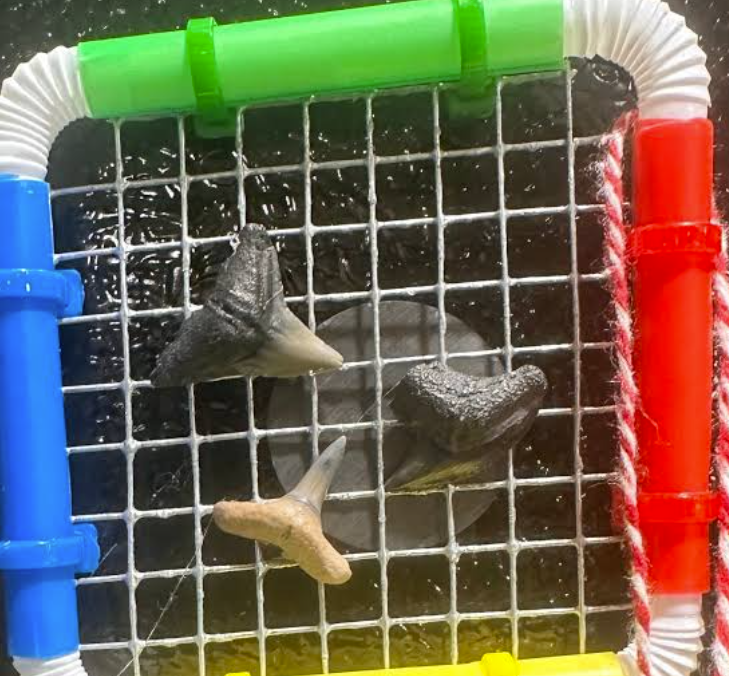
2. Floating PVC Mesh Sifters
- Design: A square 1/4-inch hardware cloth mesh box framed by floating PVC pipes with a tether rope.
- Best For: Peace River wading or calm beach waters at Stump Pass and Caspersen.
- Pros: Allows two-handed sorting while the sifter floats effortlessly next to you.
3. Hand Scoops & Mesh Bags
- Design: Small plastic or mesh hand shovels paired with a waist-pouch mesh collection bag.
- Best For: Children, beginners, and shallow beach walks.
4. Protective Footwear & Apparel
- Neoprene Booties or Water Shoes: Vital for Caspersen Beach and Peace River hunting to protect feet against sharp coquina rock, submerged timber, and jagged shell beds.
- Polarized Sunglasses: Cuts through surface water reflection so you can spot dark teeth glinting in the shallows.
8. Kid-Friendly Fossil Hunting Spots in SWFL
For families traveling with young children, choosing spots with calm water, easy parking, shade, and nearby restrooms is essential.
- Service Club Park (Venice): Paved parking, covered picnic pavilions, boardwalk access, outdoor showers, and gentle sloping shorelines packed with small shark teeth.
- Venice Fishing Pier at Brohard Paw Park: Parking right at the Pier, shaded dining options (Sharky’s on the Pier), clean restrooms, and abundant small teeth in shallow water.
- Lowdermilk Park / Nokomis Beach: Gentle wave action, soft sand mixed with shell runs, ideal for toddlers using small hand scoops.
- Peace River at Gardner Boat Ramp (Shallow Sandbars): During peak dry season (March–April), shallow clear sandbars provide a safe freshwater environment for kids to scoop and wade.
9. Pro Tips & Field Identification
How to Tell a Shark Tooth from a Dark Shell or Rock
- Glossy Enamel: Shark teeth are covered in dense enamel that retains a shiny, smooth luster even after millions of years. Rocks and shells are dull or porous.
- Distinct Shape & Symmetry: Look for a defined triangular crown, dark root structure, and clean side margins or serrations.
- Cold & Dense Feel: Fossilized shark teeth are mineralized (permineralized with phosphate and silica), giving them a heavier, cool-to-the-touch density compared to lightweight black shell fragments.
When to Hunt
- Low Tide: Arrive 1 hour before peak low tide to hunt exposed sandbars and wet gravel bands.
- Post-Storm Swells: The 24 to 48 hours following a cold front or severe storm system churn up deep offshore trenches, delivering large fossils to the tide line.
