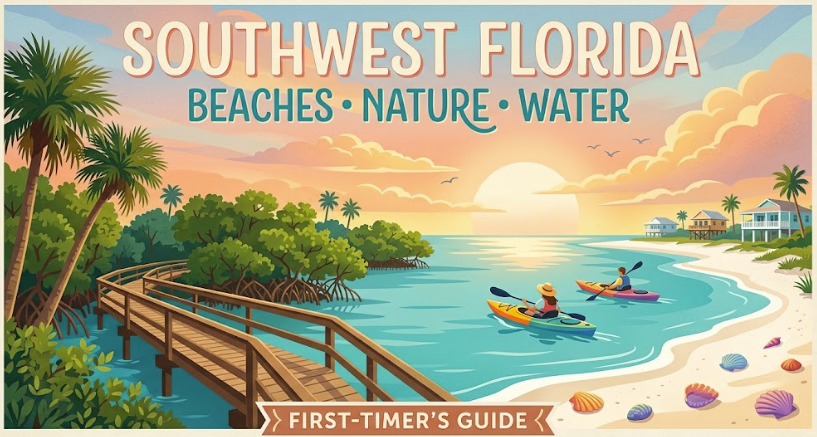
Most people who visit Southwest Florida for the first time underestimate it. They book a beach hotel, spend a few days at the pool, eat dinner on Fifth Avenue, and leave thinking they’ve done it. Then someone who actually knows the region tells them about the mangrove tunnel that glows with bioluminescence at night, or the ancient cypress forest 35 miles inland where 500-year-old trees rise above dark tannic water and barred owls perch at eye level, or the morning in October when the entire surface of a Gulf bay becomes a mirror of gold and there is nothing between you and the horizon but a kayak and the sound of a dolphin surfacing.
That is when first-timers realize they have barely scratched the surface.
Southwest Florida stretches roughly 200 miles along the Gulf Coast from the Sarasota area in the north to the Everglades wilderness in the south, encompassing the most biologically rich and recreationally extraordinary coastal corridor in the continental United States. It is simultaneously a world-class beach destination, one of the finest wildlife viewing environments in North America, a paddling and fishing paradise of the first order, and one of the few places in the country where genuine wilderness is accessible within minutes of a fine dining restaurant.
This guide is your introduction. Not the brochure version — the honest, practical, don’t-waste-your-time version that tells you what the region actually is, when to go, where to go first, and how to leave feeling like you actually saw it.
Understanding the Region: It’s Not One Place
The single most important thing a first-time visitor needs to understand about Southwest Florida is that it is not a single destination. It is a corridor of distinct communities, each with its own character, price point, atmosphere, and outdoor personality. Choosing one without understanding the others means potentially ending up somewhere that doesn’t match what you came for.
Here is a quick-read breakdown:
Sarasota is the region’s cultural and arts capital — a mid-sized city with a world-class museum campus (The Ringling), a thriving arts scene, excellent restaurants, and the beaches of Siesta Key and Lido Key just minutes from downtown. <cite index=”841-1″>Siesta Key is known for its fine sand and family-friendly atmosphere</cite>, while Lido Key offers a quieter, more relaxed beach experience. Sarasota has a younger, more urban energy than the communities to the south and attracts visitors who want both cultural richness and outdoor access. <cite index=”821-1″>In 2026, Sarasota ranked third on Google’s most trending spring break destinations in the United States</cite>, reflecting a surge in national awareness that long-time residents have been watching build for years.
Charlotte County (Punta Gorda and Port Charlotte) is the region’s hidden middle ground — quieter, more affordable, and anchored by one of the most ecologically significant and least-visited large estuaries in the Gulf, Charlotte Harbor. This is where serious anglers and paddlers go when they want the goods without the crowds. <cite index=”821-1″>Punta Gorda ranked sixth on Google’s trending spring break searches for 2026</cite>, suggesting it is becoming more visible to a broader audience.
Fort Myers and Cape Coral form the region’s largest metro area — a sprawling, canal-threaded urban landscape with remarkable outdoor access through the Great Calusa Blueway paddling trail, the Caloosahatchee River, Manatee Park, and the barrier islands of Sanibel, Captiva, and Fort Myers Beach. Cape Coral’s 400+ miles of canals make it one of the most unusual boating environments in the world. <cite index=”821-1″>Fort Myers ranked eighth on Google’s trending spring break destination searches for 2026.</cite>
Bonita Springs and Estero are the region’s transitional corridor — less urban than Fort Myers, less expensive than Naples, and positioned between the two with excellent beach access at Barefoot Beach Preserve (consistently rated one of the finest beaches in the country) and strong paddling access through Estero Bay.
Naples and Marco Island are the region’s premium end — one of the wealthiest communities in the United States, with stunning beaches, world-class dining on Fifth Avenue South and Third Street South, the Conservancy of Southwest Florida, the Naples Botanical Garden, and extraordinary proximity to the Everglades backcountry and the Ten Thousand Islands. Marco Island sits at the very edge of the Everglades and Ten Thousand Islands ecosystems, making it the southernmost urban beach community in the corridor and the natural jumping-off point for serious Everglades adventure.
When to Go: The Honest Seasonal Guide
Southwest Florida’s climate is the most important factor in planning any visit, and understanding it changes everything about when you choose to come.
The Sweet Spot: October Through April
<cite index=”1021-1″>Your best window is late October through late April: dry comfortable weather, peak shelling, manatee season, and the full lineup of Gulf sunsets.</cite> This seven-month arc is when Southwest Florida operates at its best. Temperatures run between 65°F and 82°F from November through March — warm enough for beach and water activity, cool enough for hiking, kayaking, and wildlife-watching in comfort. Rain is minimal. Mosquitoes and no-see-ums drop to their lowest annual pressure. Wildlife is at its most concentrated and visible as water levels in the inland areas drop during dry season.
The tradeoff is that this is also the region’s high season, particularly December through March when the snowbird population arrives. Accommodation prices peak. Popular restaurants require reservations. Beach parking fills early on weekends.
The insider’s pick within this window: <cite index=”1021-1″>Late October and November make a smart secondary window — the wet season has faded, temperatures are pleasant, and the winter rush hasn’t arrived yet.</cite> <cite index=”1181-1″>A Florida resident of 25 years says October is a favorite time to visit because temperatures start to cool, humidity drops, the peak summer crowds have dispersed, and many hotels offer seasonal discounts.</cite> October is also arguably the region’s most beautiful month — golden light, low-angle sun, crystal-clear water, migrating birds arriving, and fishing that many guides consider the year’s best.
Winter: Peak Season
<cite index=”1051-1″>Peak season runs December through April, with temperatures hovering around the pleasant mid-70s Fahrenheit.</cite> This is when the region is most alive with events, activities, and the social energy that makes Southwest Florida’s snowbird community such a distinctive cultural force. <cite index=”1121-1″>Winter brings bigger crowds and higher accommodation costs</cite>, but the weather is as close to perfect as outdoor recreation gets anywhere in the continental U.S.
Booking guidance: For peak-season visits (January–March), book accommodation 3–6 months in advance. Popular waterfront restaurants fill 1–2 weeks ahead. Fishing charters and guided tours should be booked months ahead during the January–April window.
Summer: Strategy Required, Rewards Available
Summer in Southwest Florida (June through September) is genuinely hot — temperatures in the low-to-mid 90s with humidity that makes midday outdoor activity demanding. Afternoon thunderstorms are a near-daily occurrence. Hurricane season runs June through November, with peak risk August through October.
The compensations are real: accommodation prices drop substantially, crowds thin dramatically, and the landscape transforms into something lush and brilliant that the dry-season version only hints at. <cite index=”1061-1″>Summer brings fewer overall visitors, creating a noticeably more relaxed atmosphere in many coastal areas. Beaches feel less crowded, reservations are easier to manage, and there’s less pressure to plan every detail in advance.</cite>
Summer strategy: start all outdoor activity before 9 a.m., plan pool or indoor midday breaks, and enjoy the outdoor world again from 4 p.m. onward. The best summer kayaking, fishing, and wildlife-watching in Southwest Florida happens in the two hours after dawn — a window that is quiet, cool enough to enjoy, and usually spectacular.
Getting Here and Getting Around
Southwest Florida International Airport (RSW) in Fort Myers is the primary regional gateway, with direct service from most major U.S. cities. Sarasota-Bradenton International Airport (SRQ) serves the northern portion of the corridor. Tampa International Airport (TPA) is a two-hour drive and offers significantly more route options for visitors coming from smaller markets.
A rental car is essentially required. Southwest Florida’s spread-out geography, minimal public transit, and the distribution of its best outdoor experiences across multiple counties and ecosystems means that attempting to experience the region without a car limits you significantly. Distances between Sarasota, Fort Myers, Naples, and the Everglades add up quickly — Naples to Sarasota is approximately 100 miles — so planning your geographic base relative to your primary interests matters.
The Beaches: Where to Go, What to Know
Southwest Florida’s beaches are the region’s most famous attribute and the first thing most visitors come for. The Gulf of Mexico’s waters are warm (72°F–88°F year-round), calm compared to the Atlantic side, and clear when conditions cooperate. <cite index=”1001-1″>Anna Maria Island, Longboat Key, and Siesta Key are among the Florida beaches most likely to have clear water on any given day.</cite>
Here is a practical breakdown of the region’s major beach destinations for first-timers:
Siesta Key Beach (Sarasota)
<cite index=”841-1″>The sand at Siesta Key is 99% quartz crystal, cool to the touch even in summer heat.</cite> This is one of the most awarded beaches in North America and for good reason — the sand is extraordinarily fine and white, the water is shallow and calm, and the beach is wide enough that even on busy weekends it absorbs crowds without feeling claustrophobic. The beach village behind the main beach access has good restaurants and bars. First-timer tip: Arrive before 9 a.m. on weekends. The parking lot fills completely by mid-morning in season.
Venice Beach and Caspersen Beach (Venice)
Venice is called the “Shark Tooth Capital of the World” and delivers on the title. <cite index=”841-1″>Venice Beach is noted for fossilized shark tooth hunting.</cite> The main Venice Beach has good facilities, a long pier with a restaurant, and reliable shark tooth finds in the surf. Caspersen Beach a mile south is wilder, more productive for serious fossil hunters, and far less crowded. First-timer tip: Bring a mesh scoop or kitchen strainer, work the surf line at low tide, and look for small black triangles among the shells. The Fossil Guy website has an excellent location guide.
Sanibel Island (Lee County)
<cite index=”841-1″>Sanibel Island is favored for shelling and nature walks.</cite> <cite index=”671-1″>Sanibel holds more than 250 species of shells, littering its roughly 15 miles of sandy beaches with millions of treasures.</cite> The island also hosts J.N. “Ding” Darling National Wildlife Refuge — one of the most productive wildlife viewing sites in the country — and a comprehensive network of bike trails. First-timer tip: Sanibel requires a toll-causeway entry. The most productive shelling is at the island’s less-developed east and west ends, particularly at Bowman’s Beach. The “Sanibel stoop” — the hunched posture of serious shell seekers — is a real phenomenon you will understand immediately on arrival.
Barefoot Beach Preserve (Bonita Springs)
<cite index=”861-1″>Often ranked among the nation’s best beaches, Barefoot Beach Preserve remains largely unspoiled, great for seashell hunting, birdwatching, and taking long walks along the shallow, warm waters.</cite> This is the locals’ choice for those who want a beautiful beach without the development and crowds of the more famous destinations. Gopher tortoises are common in the dune vegetation. Bald eagles nest in the trees behind the beach. First-timer tip: The parking lot is small and fills early. Arrive before 9 a.m. or take the water taxi from Bonita Beach Park.
Naples Beach and Naples Pier (Naples)
Naples Beach is a 7-mile stretch of white sand running the length of the city’s Gulf-front, backed by the some of the most expensive real estate in Florida. The Naples Pier — built in 1888 and rebuilt multiple times since — extends 1,000 feet into the Gulf and is the region’s most iconic sunset-viewing location. <cite index=”921-1″>A long-standing tradition for visitors to Naples is watching fiery sunsets from the Naples Pier — applauding the end of another day is genuinely common.</cite> First-timer tip: The pier parking fills well before sunset in season. Walk from a downtown restaurant or the municipal lots on 12th Avenue South.
Marco Island — Tigertail Beach (Collier County)
<cite index=”931-1″>Marco Island has an Old Florida feel with its colorful, pretty resorts, laid-back vibe, and palm tree-dotted coastline.</cite> Tigertail Beach on the island’s north end is the best public access, with a lagoon that exposes excellent shelling mudflats at low tide and consistent roseate spoonbill activity in the cool months. First-timer tip: Tigertail Beach is family-oriented, relatively uncrowded compared to more famous Gulf beaches, and one of the best bird photography locations in Collier County.
The Water: What to Do and How to Start
The Gulf of Mexico and Southwest Florida’s connected system of bays, estuaries, rivers, and backcountry waterways offer an extraordinary range of water activities for every skill level and interest.
Kayaking and Paddleboarding — The Essential Introduction
For first-timers who want to experience the region’s waterways without the commitment of fishing or sailing knowledge, a guided kayak tour of a mangrove ecosystem is the single most revelatory outdoor experience Southwest Florida offers. <cite index=”841-1″>Travelers consistently recommend kayaking through mangroves in Naples as one of the top outdoor activities in the region.</cite>
The mangrove tunnel experience — pushing a kayak into an enclosed channel where the roots arch overhead and the light filters green through the canopy — is specific to this region and available nowhere else in North America in quite the same form. Rookery Bay near Naples, the Lido Key mangrove tunnels in Sarasota, and the Estero Bay channels in Lee County all offer guided tours that require zero prior kayaking experience.
For beginners: Book a 2-hour guided tour from any of the established operators. Almost Heaven Kayak Adventures (Sarasota), Get Up And Go Kayaking (Naples), and Gulf Coast Kayak (Pine Island) all offer excellent guided experiences specifically designed for first-timers.
For those wanting more: The Great Calusa Blueway — a 190-mile marked, mapped paddling trail through Lee County’s coastal waterways — provides self-guided exploration for intermediate paddlers. Free maps and GPS coordinates are available at CalusaBlueway.com.
Wildlife on the Water
Southwest Florida’s waterways are dense with wildlife that no amount of national park experience fully prepares you for. Dolphins work the passes and channels year-round and are encountered on virtually every water outing. Manatees are present in the coastal waters from spring through fall and concentrate dramatically at Manatee Park in Fort Myers from November through March. Roseate spoonbills, great blue herons, anhingas, and ospreys are constant companions on any paddle.
Manatee Park first-timer tip: The best viewing is from late November through February. Arrive at 8 a.m. on a weekday and walk the canal overlook before the park fills. The aggregations here — sometimes dozens of animals in close proximity — are extraordinary.
Fishing — Where to Start
Southwest Florida is widely considered one of the finest inshore saltwater fishing destinations in the United States. <cite index=”901-1″>The waters hold snook, redfish, tarpon, sea trout, and permit, with different seasons producing different peak activity for each species.</cite>
For first-timers who want to fish, hiring a local guide for a half-day inshore trip is strongly recommended. The guide provides all equipment, handles licensing, knows where the fish are that day, and provides real-time instruction in the techniques that work here — making the difference between a blank day and genuine fishing success. The region’s guide community is deep and excellent: every major community from Sarasota to Marco Island has experienced inshore guides with public reputations you can verify through online reviews.
Species to target as a beginner: Sea trout on the grass flats are the most consistently catchable inshore species and provide excellent action for new saltwater anglers. Redfish are slightly harder but rewarding. Snook are the region’s signature species and require more technique — a genuine accomplishment for any angler.
Boat Tours and Cruises
For visitors who want the water experience without paddling or fishing, Southwest Florida’s tour boat ecosystem is extensive. Dolphin and wildlife cruises operate from virtually every marina in the region, with Pure Florida (Naples), Everglades Area Tours (Marco Island), and multiple Fort Myers and Sanibel operators all offering well-reviewed departures. Sunset catamaran cruises from Naples, Fort Myers Beach, and Sarasota put you on the Gulf’s surface at the specific hour when the light is at its most extraordinary.
The Nature: What to Do Beyond the Beach
Southwest Florida’s land-based natural world is the region’s best-kept secret and the experience that most dramatically exceeds first-time visitors’ expectations.
Corkscrew Swamp Sanctuary — Start Here
If you visit only one inland natural area on your first trip to Southwest Florida, make it Corkscrew Swamp Sanctuary. The 2.5-mile boardwalk through the largest remaining old-growth bald cypress forest in North America — trees over 500 years old rising above a mirror of dark swamp water — is unlike anything most visitors have experienced anywhere in the country. Wildlife encounters (barred owls at eye level, limpkins calling from the boardwalk edge, alligators drifting below the boards) are nearly guaranteed.
Logistics: Located at 375 Sanctuary Road West, Naples. Open 7 days a week from 7 a.m. Admission approximately $17. Arrive by 8 a.m. to beat organized tour groups and experience the sanctuary at its quietest and most wildlife-active.
Ding Darling National Wildlife Refuge (Sanibel Island)
<cite index=”831-1″>Riding bikes at Ding Darling National Wildlife Refuge is a consistent highlight for visiting families.</cite> The 4-mile Wildlife Drive — open to vehicles, cyclists, and walkers — passes through one of the most productive bird and wildlife observation environments in North America, with roseate spoonbills, reddish egrets, American white pelicans in winter, and an enormous diversity of wading birds visible at close range from the road. The visitor center provides excellent interpretation and current sighting information before you enter.
First-timer tip: The Wildlife Drive is open sunrise to sunset. Arrive at sunrise to catch peak activity. The drive is one-way and takes 1–2 hours by car at wildlife-watching pace, 2–3 hours by bike.
Myakka River State Park (Sarasota)
Florida’s oldest and largest state park encompasses 37,000 acres of river, lake, prairie, and hardwood hammock. <cite index=”841-1″>Several travelers recommended Myakka River State Park for hiking at Myakka River State Park as a top outdoor activity.</cite> The park’s Upper Myakka Lake is one of the best alligator viewing locations in the state (alligator density here is extraordinary), and the tram tours of the lake provide wildlife access for visitors who prefer not to hike. Sandhill cranes graze the roadsides year-round, and the birdwatching in the oak-palm hammock is excellent throughout the dry season.
The Everglades Ecosystem — Don’t Miss It
Southwest Florida is the gateway to the Everglades, and no first-time visitor should leave without at least one Everglades experience. Options scale from brief to immersive:
Most accessible: An airboat tour from a US-41 operator — Big Cypress or Billie Swamp Safari — puts you on the water in the sawgrass within an hour of Naples or Fort Myers with no physical demands.
Most scenic: Drive Loop Road off US-41 through Big Cypress National Preserve, park at any pullout, and walk toward the interior of a cypress slough. The wildlife encounter rate on a calm morning is remarkable.
Most immersive: A guided kayak day trip through the Ten Thousand Islands from Everglades City or Marco Island. <cite index=”771-1″>Guided tours through the Ten Thousand Islands to spot dolphins and shorebirds consistently earn perfect 5-star ratings from visitors.</cite>
The First-Timer’s Common Mistakes (and How to Avoid Them)
Underestimating the distances. Southwest Florida is large. The drive from Sarasota to Naples is nearly two hours. Planning to “see everything” in three days usually means seeing nothing well. Choose a geographic base that matches your primary interests and day-trip from there.
Showing up at the beach at noon in summer. The summer sun in Southwest Florida at midday is genuinely intense. <cite index=”1071-1″>Plan early mornings, pool breaks, and late dinners</cite> to make summer visits enjoyable. The best outdoor experiences — wildlife, fishing, kayaking, beach walks — happen in the first two hours after sunrise and the last two before sunset.
Skipping the inland experiences. Every first-timer comes for the beach. The ones who remember the trip for decades are the ones who also drove to Corkscrew Swamp, paddled a mangrove tunnel, or spent a morning in Big Cypress. Add at least one inland nature experience to every SWFL visit.
Not booking in advance in season. Peak season (January–March) means guides, charters, popular restaurants, and choice accommodations operate at or near capacity. Arrive planning to “figure it out” and you will spend your mornings on hold.
Ignoring the tide charts. Tides govern the entire outdoor experience on Southwest Florida’s coast — they determine where you can kayak, when the flats are exposed for shelling, when the fishing is best, and what the beaches look like. Download a free tide chart app (Tides Near Me or MyTides) before you arrive and consult it daily.
Missing October and November. The most common first-timer regret from people who visited in January or March is: “I had no idea October was even better.” <cite index=”1021-1″>Late October and November offer the sweet spot — the wet season has faded, temperatures are pleasant, and the winter rush hasn’t arrived yet.</cite> Wildlife is extraordinary, the light is golden, and everything costs meaningfully less.
Practical Basics
Sunscreen: Apply before you go outside, not after you arrive at the beach. The Gulf-reflected UV is stronger than it appears, and burns happen fast. Reef-safe options are encouraged given the ecological sensitivity of the coastal waters.
Insects: No-see-ums (biting midges) and mosquitoes are present throughout the year, peaking in the wet season (June–October). Any outdoor activity after sunset from May through October requires effective insect repellent. DEET or Picaridin-based products are the most effective for this region.
Lightning: Southwest Florida has one of the highest lightning strike rates in the United States during the afternoon thunderstorm season (May–September). Get off the water and seek substantial shelter when you hear thunder. Lightning protocols at state parks and beaches are strictly enforced and for good reason.
Wildlife: The wildlife of Southwest Florida is real, wild, and governed by federal and state protections. Do not feed alligators (illegal and results in the animal’s euthanasia). Do not approach manatees (a federal offense). Do not collect live shells on the beach (prohibited on most SWFL beaches to protect the ecosystem). Give all wildlife the space to behave naturally.
Red Tide: Southwest Florida’s coast occasionally experiences red tide — harmful algal blooms of Karenia brevis that can cause respiratory irritation and fish kills. Red tide is natural but its intensity is worsened by nutrient pollution. Before any coastal visit, check the Florida Fish and Wildlife Conservation Commission’s red tide tracker (myfwc.com) for current conditions.
Your First Three Days: A Suggested Framework
Day One: Beach orientation. Choose the beach that matches your personality from the descriptions above and spend the morning. In the afternoon, drive to Naples Pier for sunset. Dinner at a waterfront restaurant.
Day Two: Go inland. Corkscrew Swamp Sanctuary in the morning — the 2.5-mile boardwalk requires 2–3 hours. If you’re in the Fort Myers or Sarasota area, Myakka River State Park or Six Mile Cypress Slough Preserve are excellent alternatives. Spend the afternoon recovering at the pool or exploring a local market or town.
Day Three: Go on the water. Book a guided kayak tour through a mangrove ecosystem, or a dolphin/wildlife boat tour if paddling isn’t your style. This is the experience that separates Southwest Florida from every other beach destination you’ve visited — the moment you realize that what this region offers goes far beyond sand and sun.
Add a fossil hunt at Venice Beach, a morning at Ding Darling, a sunset catamaran cruise, or a day trip to Everglades City as your schedule and curiosity allow.
One Last Thing
Southwest Florida has a quality that most first-timers don’t expect and every long-term resident eventually struggles to articulate. It is not the individual beaches or the wildlife or the fishing or the food — it is the specific way that all of these things exist together in the same place, available on the same morning if you get up early enough.
You can walk a beach at dawn, paddle a mangrove tunnel before lunch, watch a wood stork colony from a cypress boardwalk in the afternoon, and eat stone crab claws at a waterfront table as the sun goes down. You can do all of that within a 30-mile radius. You can do it any day of the year.
Most people who visit Southwest Florida for the first time leave already planning to come back. That is not an accident. This place gets under your skin precisely because you leave it knowing you barely scratched the surface.
Come back and scratch deeper.
Current hours, fees, and access conditions are subject to change. Always verify details directly with venues before visiting. Obtain current Florida saltwater fishing licenses at myfwc.com before fishing. Monitor red tide conditions at myfwc.com/redtide and hurricane forecasts at nhc.noaa.gov during the June–November season.