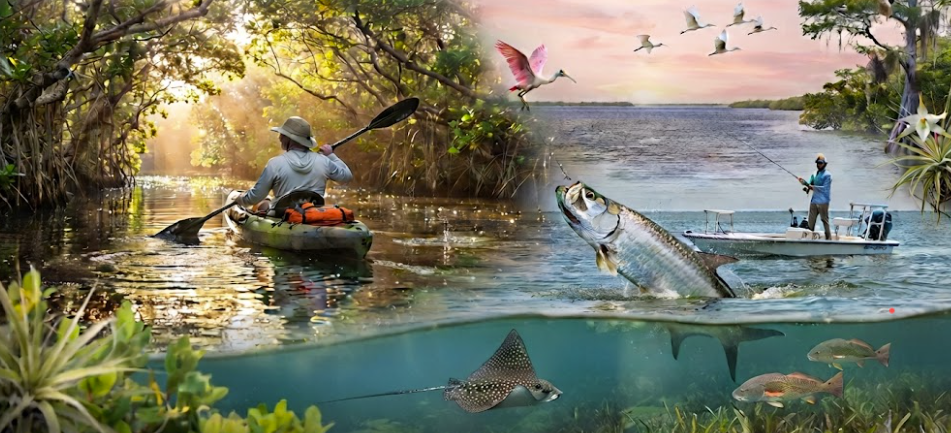
There is a version of Southwest Florida that never quite makes it into the brochures — the one that exists at 6 a.m. on a flat-calm October morning, when a tarpon rolls ten feet from your kayak in a mangrove channel that has no name on any map. The one where a roseate spoonbill lands close enough that you can hear the sound of its wings. Where a ghost orchid floats in the dark of a cypress swamp and the only other sound is the call of a barred owl somewhere deep in the canopy above.
That Southwest Florida is available to you. All of it. Without a permit, a guide, a reservation, or a passport. What it requires is the willingness to show up, the knowledge of where to go, and a bucket list worth working through.
This is that list. Fifty experiences — on the water, on the land, beneath the surface, and at the edges of wild places that most people drive past their entire lives without stopping. Some will take you an afternoon. A handful will take years to fully earn. All of them will change how you understand this stretch of Gulf Coast that is, by any honest measure, one of the most extraordinary outdoor environments in North America.
Start anywhere. Start today. But start.
On the Water
1. Paddle a Mangrove Tunnel at Sunrise
There is no experience more distinctly Southwest Florida than pushing a kayak bow-first into a mangrove tunnel as the first light begins to filter through the canopy. The dark water, the arching prop roots, the silence broken only by the soft splash of your paddle — this is the version of Florida that stays with people for the rest of their lives.
Where to go: The Lido Key Mangrove Tunnels off Ted Sperling Park in Sarasota are the most accessible. The tunnels of Rookery Bay in Naples are wilder and more enclosed. For the deepest immersion, the backcountry channels of the Ten Thousand Islands will give you miles of protected paddling with no development in any direction.
When: October through May for the best conditions. Sunrise means leaving the launch before dawn.
2. Hook a Tarpon at Boca Grande Pass
The tarpon that run through Boca Grande Pass in late spring and early summer are among the greatest concentrations of large fish anywhere in the world. These animals reach 150 pounds and make leaps that leave grown anglers speechless. Getting one to hand — or even to the boat — is considered by serious anglers to be one of the defining achievements of a saltwater fishing life.
Where: Boca Grande Pass, at the southern tip of Gasparilla Island in Charlotte County. Fish the pass itself on the outgoing tide from late April through July.
The reality: This is not beginner water. Hire a local guide for your first experience — the tide rips, the boat traffic is heavy during peak season, and the fish are large enough to require specific tackle knowledge. It’s worth every dollar.
3. Watch Manatees from a Kayak at Manatee Park
In the cooler months between November and March, the warm-water outflow at Manatee Park in Fort Myers draws manatees by the hundreds. Paddling slowly among a winter aggregation of manatees — these enormous, gentle, slow-moving animals surfacing around you with total indifference to your presence — is one of the most emotionally affecting wildlife encounters available anywhere in North America, and it is free.
Where: Launch from Manatee Park, 10901 Palm Beach Blvd, Fort Myers. Paddle upstream on the Orange River.
Best time: December through February, early morning on weekdays when the park is quiet.
4. Take a Sunset Catamaran Cruise on the Gulf
The Gulf of Mexico produces sunsets of a quality that has no equal on the eastern seaboard of the United States. The flat horizon, the salt haze, and the subtropical light combine to create color gradations — from pale gold at the horizon through every shade of orange, coral, and magenta to deep violet above — that have been attracting painters and photographers to this coast for 150 years.
Watching it from a catamaran under sail, with a cold drink in your hand and the boat tilting gently in the evening breeze, is one of those experiences that earns its place on a bucket list not because it’s adventurous but because it is perfect.
Where: Sunset cruises operate from Naples, Fort Myers Beach, Sanibel, Marco Island, and Sarasota. Pure Florida and Sanibel Sea School both run excellent guided sunset sails.
5. Catch Your First Snook
For anglers who grew up fishing the midwest or the northeast, their first snook is a revelation — a sleek, powerful fish with a black lateral stripe and a fight that is nothing like anything they’ve encountered before. Snook are the signature inshore species of Southwest Florida, they require real skill to locate and present to, and they are protected enough by regulation that catching one requires genuinely knowing what you’re doing.
Where: Focus on the canals, creek mouths, and tidal passes of Charlotte Harbor, Pine Island Sound, and the Naples Bay system. Dawn and dusk at the mouth of a moving tidal creek is the classic setup.
The learning curve: Budget 3–5 outings with a knowledgeable local before expecting consistent action. Then budget a lifetime for refinement.
6. Kayak to Mound Key — and Walk an Ancient City
Mound Key Archaeological State Park is accessible only by water — a kayak or boat trip from Koreshan State Park or Lovers Key — and once you arrive, you are standing on the former capital city of the Calusa, the powerful seafaring people who dominated this coastline for thousands of years before European contact. The shell mounds rise 30 feet above the surrounding estuary, built entirely from the discarded shells of the oysters and clams that sustained the Calusa civilization.
Paddling to a place that can only be reached by the same mode of transportation its builders used, and walking a trail that passes remnants of structures older than the United States by centuries, is a quietly extraordinary experience.
How: Rent a kayak at Koreshan State Park (3800 Corkscrew Road, Estero) and follow the Great Calusa Blueway marked trail. Round trip is approximately 6 miles.
7. Fish the Charlotte Harbor Flats for Redfish
The shallow grass flats of Charlotte Harbor hold redfish year-round, and sight-casting to tailing reds — fish rooting through the grass with their tails breaking the surface as they feed — is the purest form of inshore saltwater fishing available in Southwest Florida. When conditions are right, you can see the fish from 60 feet away, make a precise cast to a specific animal, and watch the entire sequence unfold in six inches of crystal water.
Where: The eastern shoreline of Charlotte Harbor, Turtle Bay, and the flats south of the Peace River delta. Low tide on a calm morning provides the best sight-fishing visibility.
8. Snorkel the Hard-Bottom Habitat Off Naples Pier
Naples Pier extends 1,000 feet into the Gulf of Mexico and sits over a hard-bottom reef habitat that supports an entirely different biological community than the surrounding sandy bottom. Snorkeling off the pier at low tide reveals sheepshead, mangrove snapper, sergeant majors, and the occasional sea turtle — all in warm, clear Gulf water within walking distance of downtown Naples.
When: The Gulf is clearest from November through April. Morning before 10 a.m. catches the best light and the least wind chop.
9. Do the Complete Great Calusa Blueway
The Great Calusa Blueway is a 190-mile mapped, marked paddling trail through the coastal waterways of Lee County — from Pine Island Sound through Estero Bay and up the Caloosahatchee River. Doing the entire trail in sections over a season is one of the most comprehensive ways to understand the full ecological and cultural landscape of Southwest Florida’s coastal corridor. There is no better way to learn a region than from the water at a paddler’s pace.
Planning resource: CalusaBlueway.com provides a free downloadable map and GPS coordinates for all launch points. Allow 8–12 separate day trips to cover the full trail.
10. Overnight Kayak Camp in the Everglades Wilderness
The Everglades Wilderness Waterway — 99 miles of marked paddling trail connecting Everglades City to Flamingo — is one of the last great multi-day kayaking wilderness expeditions in the continental United States. You paddle through the Ten Thousand Islands, camp on shell mound sites and chickee platforms above the water, and wake each morning to a landscape that has looked essentially the same for thousands of years.
The reality: This is an advanced undertaking requiring navigation skills, self-sufficiency, and multi-day paddling fitness. But it is a life-changing experience for those who are ready for it.
Operator: Burnham Guides and Everglades Adventures / Ivey House both offer guided Wilderness Waterway expeditions from Everglades City.
11. Dolphin Research Encounter with Sarasota Dolphin Research Program
The Sarasota Dolphin Research Program has documented a resident population of roughly 170 bottlenose dolphins in Sarasota Bay for over 55 years — the longest-running study of a wild dolphin population in the world. Joining a citizen science tour puts you in a working research vessel alongside SDRP scientists, helping to photo-identify and document specific animals with documented family histories and individual personalities that span decades. This is not a dolphin show. It is science in the field.
12. Cast for Permit on the Flats
The permit is the holy grail of Gulf Coast flats fishing — a species so spooky, selective, and unpredictable that experienced anglers joke about spending careers failing to catch one. Their ghostly silver shapes moving across shallow sand and grass flats are unmistakable, and the window between a perfect cast and a spooked fish is measured in inches and seconds. If you catch one, it earns a place in the story of your fishing life permanently.
Where: The grass flats of Sarasota Bay, Charlotte Harbor, and the backcountry flats off Marco Island all hold permit. Hire a guide who specifically targets them.
13. Watch the Sunset from Matlacha
The small fishing village of Matlacha — pronounced “Mat-la-SHAY” — sits on a narrow causeway between Cape Coral and Pine Island, and it is the most unexpectedly colorful, character-rich community in all of Southwest Florida. Galleries, bait shops, funky waterfront bars, and hand-painted buildings line a stretch of water that turns every shade of gold and copper at dusk. Watching the sun go down over Matlacha Pass with a cold drink in hand while pelicans work the water below is a genuinely wonderful way to spend an evening.
On the Land
14. Walk the Corkscrew Swamp Sanctuary Boardwalk in Wood Stork Season
From January through March, the wood stork nesting colony in the ancient cypress forest at Corkscrew Swamp Sanctuary produces one of the great wildlife spectacles in the southeastern United States — hundreds of massive white birds crowding the canopy in an aerial cacophony of courtship, nest-building, and chick-rearing. The 2.5-mile boardwalk through 500-year-old bald cypress trees is extraordinary at any time of year. During active nesting season, it is unforgettable.
When: Arrive by 7:30 a.m. on a weekday. Nesting activity peaks January through March.
15. Hunt for Shark Teeth at Caspersen Beach
Venice, Florida, is called the “Shark Tooth Capital of the World” with complete justification. The offshore fossil beds that have been eroding onto the beaches here for decades produce fossilized shark teeth from dozens of species, including occasional Megalodon specimens. Caspersen Beach — the southernmost of the Venice area beaches — is the single most productive location for fossil hunting, and spending a morning sifting the surf line with a mesh scoop is one of the most addictive outdoor activities in the region.
Tools needed: A mesh shark tooth scoop (available at Papa’s Bait Shop on the Venice Pier) and patience. The best conditions are at low tide, early morning, after a storm.
16. See a Ghost Orchid in Bloom at Fakahatchee Strand
The ghost orchid (Dendrophylax lindenii) is one of the rarest plants in North America — a leafless, rootless orchid that clings to cypress bark and produces a single floating white flower that appears to hang in mid-air above the dark swamp water. Fakahatchee Strand Preserve State Park holds the highest concentration of ghost orchids in the country. Seeing one in bloom is a Florida naturalist’s equivalent of a life bird — something that takes effort, timing, and sometimes years of trying.
How: Join a guided swamp walk offered by the park from June through August. These tours wade into the interior swamp to access known ghost orchid plants. Pre-registration required — check floridastateparks.org/fakahatchee.
17. Hike Loop Road in Big Cypress at Sunrise
The 24-mile unpaved Loop Road through the heart of Big Cypress National Preserve is one of the great wildlife corridors in the Southeast. Drive or walk it in the hour after sunrise — when alligators bask on the road surface in cool morning light, owls complete their nocturnal hunts, and the cypress domes are lit with the low golden light of early morning — and the rest of your day will feel like a sequel.
Where: Turn north off US-41 approximately 20 miles east of Naples at the Loop Road junction near Monroe Station. No fee. No facilities. GPS recommended.
18. Spot a Florida Panther Track
There are approximately 120–180 Florida panthers remaining in the wild, almost all of them in Southwest Florida. The odds of seeing one are vanishingly small. But walking a backcountry trail in the Florida Panther National Wildlife Refuge, the Big Cypress National Preserve, or Fakahatchee Strand and finding a fresh set of panther tracks in soft mud is a profound experience — confirmation that you are sharing a wild landscape with one of the rarest large predators in North America.
Where: The Florida Panther National Wildlife Refuge (12085 SR 29 South, Immokalee) is open Wednesday–Sunday and offers the best habitat access for finding panther sign.
19. Bird the Celery Fields at Migration Peak
The Celery Fields in eastern Sarasota is consistently rated one of the finest birding sites in all of Florida — a stormwater facility whose retention ponds and berm trails attract extraordinary shorebird diversity during spring and fall migration. During an active spring migration morning in April or May, the shorebird assemblages on the mudflat exposures can include 20+ species in a single view.
When: April–May for northbound migration. July–September for southbound shorebirds. Arrive at sunrise.
20. See a Swallow-Tailed Kite
If you have never watched a swallow-tailed kite hunt, the first time stops you cold — a large, black-and-white raptor with a deeply forked tail, flying with a fluid aerial grace unlike any other bird in North America, snatching dragonflies and lizards from mid-air without breaking its glide. These birds return to Southwest Florida from South America every March and are present through July.
Where: CREW Marsh, Fakahatchee Strand, and the open prairies of Big Cypress are reliable locations. A clear morning in April, any preserved area with open sky, almost guarantees a sighting.
21. Walk a Boardwalk Through Fakahatchee Strand’s Royal Palms
The native royal palm hammocks within Fakahatchee Strand are among the most photographically compelling natural subjects in all of Southwest Florida — smooth silver trunks rising 60–80 feet above the dark swamp water, backlit by morning light, surrounded by bromeliads and Spanish moss. Jane’s Scenic Drive through the preserve passes several hammocks accessible from the road margin.
22. Find a Roseate Spoonbill at Ding Darling
The roseate spoonbill’s coloration — a shocking, almost artificial pink that intensifies on the wings and breast — is the most startling visual experience in Gulf Coast birdwatching. These birds are present at Ding Darling National Wildlife Refuge on Sanibel year-round, with peak numbers in the fall and winter months. Getting your first close look at one feeding in the tidal shallows of the Wildlife Drive will change how you see the color pink permanently.
When: Arrive at the Wildlife Drive at opening (sunrise) on a weekday. Low tide on the west side of the drive is the highest-probability spoonbill scenario.
23. Fossil Hunt on the Peace River
The Peace River near Arcadia and Zolfo Springs is one of the most productive freshwater fossil hunting sites in the country — a slow-moving river whose shallow, sandy bottom yields shark teeth, mammoth teeth, horse bones, and the occasional Megalodon tooth eroding from sediment layers deposited millions of years ago. Wade in with a mesh basket and spend a morning sifting the bottom. What you pull out will change your sense of geological time.
Access: Multiple outfitters near Arcadia rent canoes for the Peace River and can drop you at productive fossil sections. Canoe Outpost Peace River is the most established operator.
24. See Wood Storks Nesting at the T.M. Goodlette-Frank Road Rookery
This active wading bird rookery in Naples — visible from the road along T.M. Goodlette-Frank Road — hosts nesting wood storks, anhingas, and various herons at close range from February through April. It is one of the most accessible and productive urban wildlife viewing experiences in Collier County, and it is invisible to the majority of Naples residents who drive past it daily.
25. Hike the CREW Flint Pen Strand Loop
CREW’s Flint Pen Strand trail is a 7.5-mile loop through mature cypress domes, pine flatwoods, and hardwood hammock in eastern Lee County that delivers a true backcountry hiking experience entirely free of charge and almost entirely free of crowds. It is the kind of trail that makes you feel like you’ve discovered something privately, even though it has been there all along.
26. Watch the Bald Eagle Nest at Lake Manatee or Myakka River
Bald eagle nest monitoring in Southwest Florida has become an annual community ritual. Myakka River State Park and the Sarasota County area maintain documented active nests that are visible with binoculars from established viewing areas. Watching a bald eagle deliver a fish to a nest full of chicks in the February sunshine is one of those wildlife moments that transcends the category.
27. Camp Overnight in Big Cypress
The primitive campgrounds along Loop Road in Big Cypress — Midway, Pinecrest, Monument Lake — put you in the middle of the preserve at the hours when the landscape comes alive: dusk, when the owls begin calling; predawn, when the first birds move; and the deep silence of a clear night under a sky that has no light competition for miles in any direction.
Cost: Free. No reservation required at most primitive sites. Bear box or canister required for food storage.
28. See Bioluminescence in SWFL Waters
On warm nights during summer and early fall, certain organisms in Southwest Florida’s coastal waters produce bioluminescence — a cold blue-green light triggered by movement that makes every paddle stroke glow and every fish that passes through the water leave a trail of light behind it. Kayaking through a bioluminescent bay on a dark night, watching the water light up around you, is one of the most otherworldly natural experiences available anywhere in Florida.
Where: The phenomenon occurs in protected bays and backwaters during warm months. Rookery Bay, Estero Bay, and the mangrove channels of Marco Island are all reliable locations in good years. Guided night tours are offered by several Naples and Marco Island operators.
29. Explore Cayo Costa by Foot
Cayo Costa State Park is a 9-mile barrier island accessible only by boat or ferry — no bridges, no roads, no development. The island’s Gulf-side beach is one of the longest stretches of undeveloped sand in Southwest Florida, the interior trails wind through subtropical hammock and pine flatwoods that feel genuinely wild, and the combination of remote beach, abundant wildlife, and total absence of crowds makes it one of the finest day-trip destinations in the region.
Access: Island ferry from Pine Island (tropic-star.com) or private boat. Arrive early — parking at the Pine Island ferry landing fills on weekends.
30. Stand on the Observation Deck at Six Mile Cypress Slough at Nesting Season
The elevated boardwalk at Six Mile Cypress Slough Preserve in Fort Myers puts you at mid-canopy height in a flowing cypress slough — and from January through April, that canopy is occupied by active great blue heron, great egret, and anhinga nesting colonies visible at close range. Watching the full sequence of colonial waterbird nesting — courtship displays, nest-building, egg incubation, and chick-rearing — from a boardwalk that requires no wilderness travel is an extraordinary natural history experience disguised as a neighborhood park.
In the Wild Places
31. Photograph the Barred Owls at Corkscrew
The barred owls that inhabit the Corkscrew Swamp Sanctuary boardwalk have become so accustomed to human presence that they regularly perch at eye level within arm’s reach of visitors — producing close-range wildlife photography opportunities that would be impossible to replicate in any other setting. For wildlife photographers, this is one of the most remarkable locations in the country.
32. Airboat Through the Everglades
There is nothing quite like the experience of an airboat — flat-bottomed, fan-powered, skimming across open sawgrass prairie at 30 miles an hour with alligators visible in the sloughs on both sides and an osprey circling overhead. It is loud, it is fast, and it is a completely Florida experience that has no equivalent elsewhere.
Where: Multiple airboat operators on US-41 between Naples and Miami offer tours of varying duration and price. Billie Swamp Safari on the Big Cypress Seminole Reservation offers an experience that includes cultural context alongside the wildlife.
33. Find a Live Loggerhead Sea Turtle Nest
From May through October, female loggerhead sea turtles emerge from the Gulf at night to lay their eggs on Southwest Florida beaches. Finding a nest — identified by the characteristic body pit and crawl tracks in the sand — and understanding what it represents connects you directly to one of the oldest biological cycles on Earth. These animals have been nesting on these beaches for millions of years.
How: Mote Marine Laboratory leads guided turtle monitoring walks on Sarasota County beaches during nesting season. The experience of watching a 250-pound sea turtle emerge from the surf under a starlit sky is extraordinary.
34. Walk the Beaches of Marco Island at Low Tide in Winter
Marco Island’s Tigertail Beach and the sand bars beyond it at low winter tide reveal a world of shorebirds, shells, and tidal flat life that most visitors to Marco Island never see. American oystercatchers nest on the exposed bars. Wilson’s plovers pace the tide edge. The shelling, particularly after a cold front pushes material onshore, is exceptional.
35. Volunteer for a Conservation Project
The conservation work described in these pages — sea turtle monitoring, Corkscrew Swamp restoration, CREW land management — depends on volunteers. Participating directly in a conservation workday, a beach cleanup, or a wildlife monitoring survey transforms your relationship with these places from visitor to invested community member. Contact Mote Marine Laboratory, CREW Land Trust, or the Conservancy of Southwest Florida for current volunteer opportunities.
Experiences That Will Test You
36. Complete a Full Great Calusa Blueway Section in One Day
Pick any of the three Blueway regions — Estero Bay, Pine Island Sound, or the Caloosahatchee — and paddle an extended section in a single day: 15–20 miles with tidal timing planned in advance. This is the workout that builds the paddling fitness for everything more ambitious.
37. Kayak the Sandfly Island Loop in the Ten Thousand Islands
The Sandfly Island Loop trail — about five miles through the outer islands of the Ten Thousand Islands refuge with a landing and hike on Sandfly Island itself — is the ideal introduction to backcountry paddling for intermediate kayakers. It is remote enough to feel genuinely wild, short enough to complete safely in half a day, and beautiful enough to produce the specific feeling of satisfaction that only real wilderness access delivers.
38. Run a Trail at CREW at Sunrise
The Bird Rookery Swamp Trail and the Flint Pen Strand loop at CREW offer some of the finest early morning trail running in Southwest Florida — flat, quiet, wildlife-rich, and open to the kinds of dawn encounters with deer, turkey, and sandhill cranes that make a 5 a.m. alarm clock feel like a reasonable investment. The flatwoods at first light, with dewfall on the pine needles and red-shouldered hawks calling from the cypress edges, are genuinely beautiful.
39. Try Kitesurfing or Wing Foiling on the Gulf
The Gulf Coast’s consistent winter onshore winds and warm water make it one of the best kitesurfing and wing foiling environments in the country for people learning these sports. The learning curve is real and the commitment of an introductory course is meaningful — but the payoff of generating your own power from the wind and gliding across the Gulf’s surface is unlike anything else on this list.
40. Complete the Wilderness Waterway (The Ultimate)
This is the list’s hardest bucket item and its greatest reward. The 99-mile Everglades Wilderness Waterway, completed over 7–10 days of paddling and camping, is a genuine wilderness expedition in one of the most biologically extraordinary places on Earth. It requires preparation, experience, and commitment. It delivers something that very few outdoor experiences can — the knowledge that you have navigated something genuinely large, genuinely wild, and genuinely your own.
Moments Worth Chasing
41. Watch the Sunset from Naples Pier
The Naples Pier is the most iconic vantage point for Gulf sunsets in Collier County, and on evenings when the conditions are right — a layer of marine haze on the horizon, enough humidity to refract the light into extraordinary color gradients — the sun descends into what looks like a burning sea. Come early to claim your spot. Bring everyone you love.
42. Eat Stone Crab Claws at a Waterfront Restaurant in Season
Stone crab season in Florida runs October 15 through May 1, and eating fresh stone crab claws — cracked tableside with mustard sauce, with the Gulf visible from your table — is one of the great regional food experiences of the American South. This is not an outdoor activity in the conventional sense. It is a celebration of what this coast produces, which makes it fully part of the bucket list.
43. Find Your First Junonia Shell on Sanibel Island
The Junonia is Sanibel’s holy grail shell — a large, spotted, beautifully patterned shell that washes up rarely enough that local newspapers have historically photographed the people lucky enough to find one. Sanibel Island’s beaches hold more than 250 species of shells, and spending a morning doing the “Sanibel Stoop” — the hunched posture of serious shell seekers — in the hour after low tide is a pursuit that combines fresh air, quiet focus, and the same treasure-hunting instinct that makes fossil hunting so addictive.
44. Rent a Boat and Spend a Day on Pine Island Sound
Pine Island Sound is one of the most beautiful bodies of water in Southwest Florida — a shallow, island-threaded estuary of extraordinary biological richness, accessible by small boat from multiple launch points around Pine Island, Cape Coral, and Fort Myers Beach. A day spent exploring its mangrove islands, fishing its grass flats, anchoring in its shallows for a swim, and watching dolphins work the tidal currents is the definition of a perfect Gulf Coast day.
45. Visit Clyde Butcher’s Big Cypress Gallery
Clyde Butcher’s large-format black-and-white photographs of Southwest Florida’s wild landscapes are among the most powerful images ever made of the American South. His gallery and studio, located on US-41 deep in the Big Cypress, is open to the public and displays prints made directly from his negatives. Walking through that gallery before or after a day in the swamp connects the experience to art in a way that deepens both.
Address: 52388 Tamiami Trail, Ochopee, FL 34141.
46. Take a Glass-Bottom Kayak Tour at Night
Several Naples and Marco Island operators offer night kayak tours in clear-hull kayaks — boats whose transparent hulls allow you to see directly into the water below as you paddle. In summer and fall, these tours intersect with bioluminescence season, and the combination of seeing glowing water below your feet and around your paddle through a transparent boat hull is genuinely extraordinary.
47. Photograph a SWFL Sunrise from the Water
You will never fully understand why photographers fly from across the country to Southwest Florida until you are on the water at the precise moment the sun clears the horizon on a calm October morning — when the entire surface of the bay becomes a mirror of gold and coral, every mangrove reflected in perfect symmetry, and the first osprey begins its morning patrol against a sky that hasn’t decided what color to be yet.
Set an alarm. Get on the water before the sun rises. Bring your camera. This is what all the fuss is about.
48. See a Waterspout Over the Gulf
Southwest Florida’s afternoon thunderstorm season (June–September) regularly produces waterspouts — rotating columns of moist air over warm Gulf water that look exactly like tornadoes touching down at sea. Watching one form and track across the surface from a safe vantage point on shore is one of those unplanned, unmissable moments that the natural world of Southwest Florida regularly produces for people who spend time outside.
49. Spend a Full Moon Night on the Beach
The full moon rises over the Gulf from the barrier island beaches of Southwest Florida with a quality of light that is specific to this place — the combination of warm air, salt mist, and reflective water amplifying the moonlight into something that requires no artificial illumination to walk by. Night herons call from the mangrove edges. Bioluminescence sometimes glows in the surf. The beach is empty. This is Southwest Florida at its most quietly perfect.
50. Stand at the Edge of the Everglades and Understand Where You Are
Drive out on Loop Road or US-41 to any of the Big Cypress visitor pullouts on a clear winter morning and stand at the edge of a sawgrass prairie that extends without interruption to the horizon. No buildings. No roads visible in any direction. Just an ancient, living landscape that has been filtering water, cycling nutrients, and sustaining life for tens of thousands of years — longer than any human civilization, longer than any recorded history, longer than any ambition or achievement the human world has produced.
Stand there for a while. The list can wait.
Your Bucket List, Your Pace
Southwest Florida’s outdoor environment does not sort itself by difficulty or sequence. You can do number 50 on your first day and number 10 in your tenth year. The list is not a ranking — it is a menu, and the only wrong way to use it is not to.
What the list does is make visible what residents who spend most of their time indoors never quite appreciate: that they live in the middle of one of the most extraordinarily rich outdoor environments on Earth. That the tarpon and the ghost orchid and the bioluminescent bay and the perfect sunset and the fossil beach and the ancient cypress forest are all within an hour’s drive. That the experience of genuinely knowing this region — knowing where the spoonbills are in October, knowing what the tide needs to be for the redfish to tail, knowing the specific bend in the mangrove tunnel where the barred owl always sits — is one of the most available and underused forms of wealth that Southwest Florida offers.
The water is warm. The land is wild. The bucket is empty.
Start filling it.
