Category: On The Land | Tags: Corkscrew Swamp, birding, hiking, Naples, Collier County, wildlife, wood storks
There is a moment about halfway through the Corkscrew Swamp Sanctuary boardwalk — somewhere in the ancient cypress forest, with 500-year-old trees rising above you like the columns of a drowned cathedral and a mirror of dark tannic water below — when most visitors go quiet. Not because they’ve been asked to. Because the place does something to people.
Corkscrew Swamp Sanctuary is one of the most extraordinary natural places in North America. It is not a dramatic landscape in the way that a mountain or canyon is dramatic. It is subtle, still, and ancient — which makes the impact it produces all the more surprising. People who have hiked national parks from Yellowstone to the Smokies consistently describe Corkscrew as unlike anything they’ve experienced.
This guide tells you everything you need to know to visit well.
What Is Corkscrew Swamp Sanctuary?
Corkscrew is a 13,000-acre sanctuary owned and managed by the National Audubon Society, located in northeastern Collier County about 35 miles northeast of Naples. At its heart is the largest remaining stand of old-growth bald cypress forest in North America — trees that were already centuries old when the first European settlers arrived in Florida.
The sanctuary was established in 1954 specifically to protect the last major nesting colony of wood storks in the continental United States. That mission has expanded over the decades to encompass protection of the entire watershed ecosystem, including pine flatwoods, wet prairie, and the swamp forest itself.
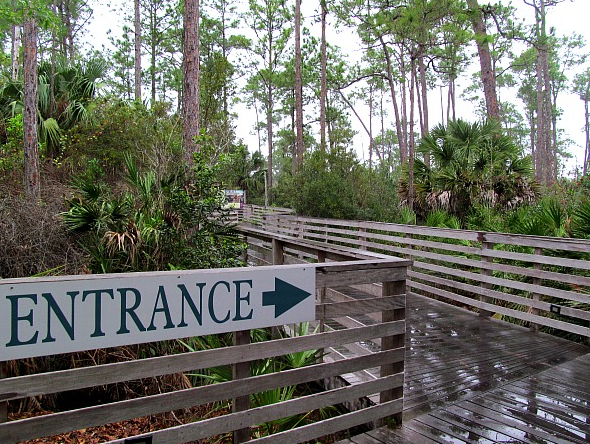
The centerpiece for visitors is a 2.5-mile elevated boardwalk that winds through all four major habitat types. It is entirely flat, entirely accessible, and entirely unlike any other trail in the region.
The Wildlife: What You’re Actually Likely to See
Wood Storks
The signature species and the reason the sanctuary exists. Wood storks are the only stork native to North America and one of the largest wading birds on the continent, standing nearly four feet tall with a wingspan of over five feet. Their nesting colony at Corkscrew — which peaks January through March — is one of the great wildlife spectacles in the southeastern United States: hundreds or thousands of large white birds crowding the canopy of the old cypress trees in a chaos of courtship, nest-building, and chick-rearing.
Nesting is not guaranteed every year. It depends on water levels in the broader watershed — wood storks require specific water recession patterns to concentrate fish within their feeding range. In good nest years, Corkscrew becomes a destination for naturalists and photographers from around the world.
Barred Owls
Among the most reliably encountered large birds at Corkscrew. Barred owls along the boardwalk have become accustomed to human presence and often allow very close approach, perching at or below eye level in the mid-story vegetation. They are most active at dawn and dusk but are frequently seen throughout the day in the dense shade of the cypress forest.
Limpkins
The swamp’s ghost — a large, chocolate-brown wading bird with a haunting, prehistoric wail that echoes through the cypress at dusk. Limpkins specialize almost exclusively in eating apple snails, and Corkscrew’s wet areas support a dense population. Walking the boardwalk at dawn often produces multiple close-range limpkin encounters.
Anhingas and Great Blue Herons
Both are common year-round throughout the sanctuary. Anhingas are particularly dramatic at Corkscrew — large, prehistoric-looking birds that swim underwater to catch fish and then spread their wings to dry, as they lack the waterproofing oils of ducks and cormorants.
Florida Black Bears
Corkscrew sits within active Florida black bear habitat. Bears are occasionally seen crossing the boardwalk in early morning hours or feeding along the wet prairie edges. Sightings are uncommon but not rare, and tracks are frequently observed in the mud near the water’s edge.
Alligators
Present throughout the wet areas year-round. In dry season (December–April), alligators concentrate around the remaining water bodies near the boardwalk and are often highly visible. They are accustomed to the boardwalk’s presence and are not defensive, but the standard precaution of maintaining distance and never feeding them applies absolutely.
Ghost Orchids
Perhaps the most sought-after sighting in all of South Florida’s natural world. Corkscrew is one of the most reliable locations to see ghost orchids (Dendrophylax lindenii) in their natural habitat. These rare, rootless orchids grow directly on the bark of cypress and pop ash trees, blending almost invisibly into the bark until they produce their extraordinary white blooms — a single floating flower with no visible stem or leaves.
Ghost orchids bloom primarily June through August. The sanctuary offers occasional guided ghost orchid tours during peak bloom periods. Check the Audubon website for dates.
The Boardwalk: Section by Section
The 2.5-mile boardwalk is divided into distinct ecological zones, each with its own character.
Pine Flatwoods (Start): The walk begins in open pine flatwoods — bright, airy, and very different from the dark swamp forest ahead. This section is good for ground-nesting birds, gopher tortoises (look for their burrows), and the Eastern bluebirds that inhabit the understory.
Wet Prairie: Open, grassy wetland with good visibility in all directions. In winter, this area attracts sandhill cranes, white ibis, and large flocks of wading birds. The open sky here makes it excellent for raptor observation — swallow-tailed kites in spring and summer, ospreys year-round.
Pond Cypress Swamp: A transitional habitat before the deep swamp, with shorter, thinner cypress trees and more open water. Alligator concentration here is typically higher than in the old-growth section.
Old-Growth Bald Cypress Forest: The heart of Corkscrew and the reason most visitors come. The trees here are massive — trunks six feet in diameter, flared bases disappearing into dark water. The boardwalk here is quiet and dim, filtered light coming through a canopy 80–100 feet above. The wood stork nesting colony is accessed from this section.
Lettuce Lakes: Broad, open water bodies covered in floating vegetation, excellent for limpkins, anhingas, purple gallinules (brilliantly colored, look carefully), and the occasional river otter.
Planning Your Visit
Hours and Admission
The sanctuary is open year-round. Hours vary by season — typically 7:00 AM to 5:30 PM in peak season, slightly shorter in summer. Current admission is approximately $17 for adults, $8 for children, and free for Audubon members. Always verify current hours and fees at the official Audubon website before visiting: corkscrew.audubon.org.
When to Visit
Peak season (January–March) is when Corkscrew is at its most spectacular. Wood stork nesting activity, peak dry-season wildlife concentration, and ideal weather coincide. Weekends can be crowded; weekday mornings are dramatically quieter.
Spring (April–May) is excellent for birding as migrants move through. Water levels are dropping and wildlife concentrates around remaining water.
Summer (June–September) is hot, humid, and rainy, but the sanctuary is transformed. The whole landscape is flooded and brilliantly green, ghost orchid blooms are possible, and the crowds disappear entirely. Bring serious insect repellent and start early.
Fall (October–November) is a transition season with good birding and comfortable temperatures returning. Water levels begin dropping and dry-season wildlife patterns reassert.
What to Bring
- Binoculars (essential — invest in at least 8×42 optics if you’re serious about wildlife)
- Camera with telephoto reach (minimum 300mm equivalent)
- Insect repellent (year-round, heavier application May–October)
- Water and snacks (no food service on the trail)
- Light layers — the old-growth cypress forest is significantly cooler than the surrounding flatwoods
Getting There
Corkscrew Swamp Sanctuary is located at 375 Sanctuary Road West, Naples, FL 34120. From I-75, take Exit 111 (Immokalee Road / SR 846) east approximately 15 miles to Sanctuary Road, then right for 1 mile to the parking area. The entrance road is well-marked.
There is a visitor center at the trailhead with restrooms, educational exhibits, and knowledgeable staff naturalists who can brief you on current wildlife conditions and activity before you walk.
Guided Programs and Special Events
The Audubon Society offers a range of guided programs throughout the year, including:
- Early morning bird walks with staff naturalists (October–April)
- Ghost orchid tours during peak bloom season (June–August)
- Photography workshops for wildlife and nature photographers
- School and group programs for youth and educational groups
- Volunteer stewardship days for those who want to contribute to the sanctuary’s maintenance and restoration
These programs require advance registration and fill quickly during peak season.
Photography at Corkscrew
Corkscrew Swamp Sanctuary is one of the finest wildlife photography locations in the United States. The combination of habituated wildlife, consistent subjects, extraordinary light conditions, and dramatic settings produces images that would require expeditions to remote wilderness areas to replicate elsewhere.
Key tips for photographers:
The first and last 90 minutes of daylight produce the best light in the cypress forest — the angle and warmth of the light filters beautifully through the canopy during these windows.
For wood stork nesting shots, a 500mm or 600mm lens is ideal for capturing behavior at the nest level. Arrive before sunrise and stake out a position in the old-growth section near the active nesting trees. Movement and noise scatter the birds.
Barred owls at Corkscrew frequently sit close enough to the boardwalk for impressive portraits with a 300mm lens. They are most cooperative in early morning when their hunting activity overlaps with visitor hours.
For the wet prairie sections, a wide-angle lens (24–70mm range) captures the scale of the open landscape and the relationship between the birds and their environment — a different but equally powerful perspective than the telephoto isolations.
Conservation Context
Corkscrew Swamp Sanctuary does not exist in isolation. It is the northernmost major anchor of a watershed system that flows south through the Fakahatchee Strand, the Florida Panther National Wildlife Refuge, and ultimately into the Ten Thousand Islands and Everglades. The health of this entire corridor depends on water flowing freely through it — which puts Corkscrew at the center of a broader conservation story about Everglades restoration, agricultural water management, and the future of South Florida’s natural systems.
When you pay admission and visit Corkscrew, that money directly funds land management, water quality monitoring, research, and the educational programs that build the next generation of conservation advocates for this region. It is one of the most direct connections a visitor can make between recreational enjoyment and active conservation investment.
Corkscrew Swamp Sanctuary deserves more than a single visit. It is one of those places that reveals itself slowly, differently each time, always with something you missed before. Go once for the introduction. Go back for the relationship.