Category: On The Land | Tags: Big Cypress, backcountry, hiking, Everglades, Collier County, camping, wilderness
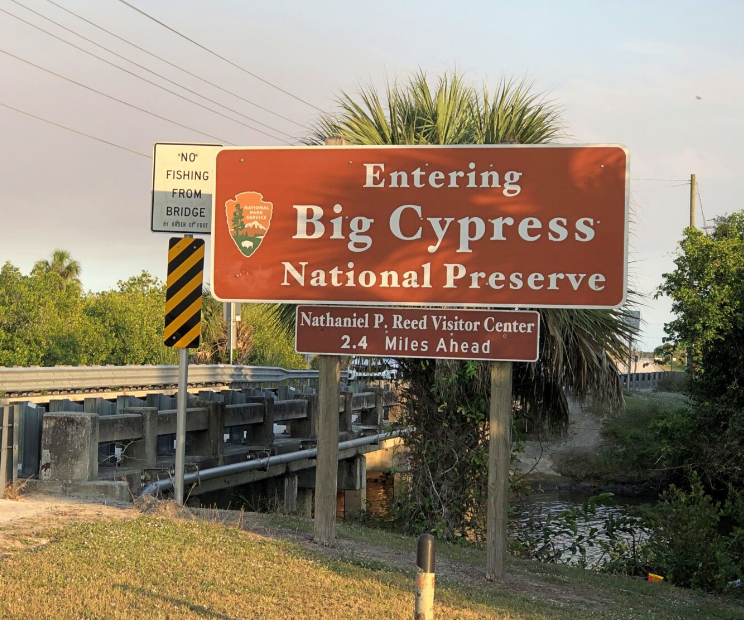
Big Cypress National Preserve covers 729,000 acres of South Florida wilderness — roughly the size of Rhode Island — and most of it is accessible to anyone willing to drive a dirt road, lace up a pair of boots, and step off the pavement. Yet for most Southwest Florida residents, Big Cypress exists as a blur seen from the car window on US-41: flat, green, vaguely mysterious, and apparently featureless.
It is none of those things up close.
Big Cypress is one of the most ecologically complex and visually extraordinary wild landscapes in North America. Its apparent flatness conceals a mosaic of distinct habitats — pine islands, cypress domes, wet prairies, dwarf cypress flats, and hardwood hammocks — each with its own atmosphere, wildlife, and character. Learning to read this landscape is one of the most rewarding skills an outdoor enthusiast in Southwest Florida can develop.
This guide is for people who are genuinely new to Big Cypress. It tells you where to start, what to expect, what you need, and how to stay safe in a wilderness environment that is more remote than it appears from the highway.
Understanding the Landscape First
Before you go, it helps to understand what Big Cypress actually is — because it’s not what most people picture when they imagine a Florida swamp.
Despite the name, Big Cypress is not named for trees of exceptional size. It’s named for the expanse of cypress habitat — “big” meaning large in area, not large in stature. In fact, much of the preserve is covered in dwarf cypress — stunted, gnarled trees only 5–15 feet tall that grow in nutrient-poor, seasonally flooded marl limestone. These dwarf cypress prairies stretch to the horizon and have an eerie, otherworldly beauty unlike anything else in North America.
The taller, more iconic cypress — the cathedral forests of massive trees — are found in specific locations where the limestone is deeper and the soil conditions richer. Loop Road and the sloughs feeding the deeper strand areas support these trees.
The landscape is also not static. Big Cypress breathes seasonally, flooding 8–12 inches deep across vast areas during the wet season (May–October) and drying to a cracked, brown pan in the dry season (November–April). These two faces of the preserve are profoundly different experiences.
The Best Entry Points for Beginners
1. Oasis Visitor Center — Your First Stop
Location: 52105 Tamiami Trail East (US-41), Ochopee, FL 34141 GPS: 25.8580° N, 81.0318° W
Before you go anywhere in Big Cypress for the first time, stop at the Oasis Visitor Center on US-41. The staff here are knowledgeable, friendly, and genuinely enthusiastic about the preserve. They can tell you current water levels, recent wildlife sightings (alligator concentrations, bear activity, panther camera trap data), trail conditions, and which areas are most rewarding right now.
The visitor center also has a 30-foot observation deck over a large canal that regularly holds dozens of alligators, river otters, and wading birds — one of the most accessible wildlife observation points in South Florida. It costs nothing and takes ten minutes, and it gives you an immediate sense of the preserve’s biological richness.
2. Loop Road (State Road 94)
Entry: Off US-41, approximately 20 miles east of Naples. Turn north at the marked junction near Monroe Station. Distance: 24-mile unpaved loop returning to US-41 at Forty Mile Bend GPS Start: 25.7964° N, 81.0775° W
Loop Road is the single best introduction to Big Cypress for beginners. It’s a public road — accessible by any standard vehicle in dry season — that takes you 24 miles through the heart of the preserve. You can drive it, walk sections of it, or park at any point and explore on foot.
The road passes through cypress sloughs, hardwood hammocks, and open wet prairie. Wildlife density here is extraordinary: alligators bask on the road surface in cool weather, great horned owls hunt from roadside branches at dusk, Florida panthers cross the road regularly (trail cameras confirm this — your chances of seeing one are slim but non-zero), and the birding is superb throughout the year.
For a first-time foot exploration: Park at the H.P. Williams Roadside Park off US-41 near the Turner River Road intersection and walk west along Loop Road for 2–3 miles, then return. The first few miles pass through some of the most wildlife-rich habitat on the road and the walking surface is firm and easy in dry season.
3. Turner River Road / Tamiami Canal
Entry: Turner River Road off US-41 at Ochopee GPS: 25.8421° N, 81.0793° W
Turner River Road runs north from US-41 through pine flatwoods and cypress habitat to the Tamiami Canal. Walking any portion of this road gives you immediate access to wildlife — the canal paralleling the road system holds large alligator populations year-round, and the pine flatwood edges support red-shouldered hawks, swallow-tailed kites (in season), and wild hogs that root through the roadside vegetation.
This is a shorter, more easily managed first outing than Loop Road. Two to four miles out-and-back takes two hours and almost guarantees significant wildlife encounters.
4. Monument Lake Campground Area
Location: US-41 west of Ochopee GPS: 25.8719° N, 81.1347° W
Monument Lake is a small natural lake off US-41 with a campground and a short trail system. For absolute beginners, this is perhaps the lowest-commitment entry point — the lake attracts wading birds and waterfowl year-round, alligators are reliably present along the banks, and the short surrounding trail introduces you to the transition zone between cypress swamp and pine upland.
Designated Hiking Trails for Beginners
Big Cypress has a limited number of formally designated hiking trails relative to its enormous size. Most exploration happens on off-road vehicle (ORV) trails, unpaved roads, and through cross-country travel. But the designated trails are the right starting point.
Florida National Scenic Trail — Big Cypress Section
Distance: 28 miles (through-trail, day sections possible) Difficulty: Moderate to Strenuous Surface: Natural, often flooded GPS Northern Terminus: Off I-75 at Alligator Alley rest stop, 26.0458° N, 80.8769° W
The Florida National Scenic Trail passes through the heart of Big Cypress on its route from the Gulf Coast to the Georgia border. The Big Cypress section is considered the trail’s most challenging — and most spectacular — segment.
The full 28-mile section is not a beginner undertaking. But day sections are manageable for anyone fit and prepared. The southern trailhead near US-41 passes through magnificent cypress dome and slough habitat in the first several miles before the trail enters the more remote interior.
Beginner recommendation: Enter from the southern trailhead and hike north for 3–5 miles before returning. You’ll cross cypress domes, traverse open sawgrass prairie, and walk through pine island hammocks — a representative cross-section of the Big Cypress mosaic in a single outing.
Critical note: This trail floods knee-to-waist-deep in wet season (June–October). Dry-season hiking (November–April) is the appropriate choice for beginners.
Fire Prairie Trail
Distance: 6.3-mile loop Difficulty: Easy to Moderate GPS: 25.9053° N, 81.0547° W
Fire Prairie Trail is one of Big Cypress’s most manageable loop trails for beginners. It passes through pine flatwoods and open prairies that have been shaped by the NPS’s active prescribed burning program — creating a patchwork of habitat ages that supports exceptional bird diversity.
The trail is marked and navigable but not manicured. Surface conditions vary with seasonal water levels. Early morning visits produce good chances of deer, turkey, and sandhill crane encounters in the prairie sections.
Wildlife: What You May Encounter
Florida Panther
Big Cypress contains the core of the Florida panther’s remaining wild population — approximately 120–180 individuals. Seeing one is genuinely unlikely: they are crepuscular, rarely approach humans, and their territory ranges cover hundreds of square miles. But you are unambiguously in their territory, and NPS trail cameras confirm panther activity on every major trail in the preserve.
Your realistic interaction with panthers at Big Cypress is the knowledge that they are present. That knowledge changes how a trail feels.
American Alligator
The most commonly encountered large wildlife in Big Cypress. Alligators are present in every wet habitat, bask on roads and trail surfaces on cool mornings, and show no fear of humans because they’ve rarely been harassed here. The standard rule: maintain 15 feet minimum distance, never approach, never feed. An alligator that has been fed human food becomes a nuisance animal that NPS is required to euthanize.
Black Bear
Florida black bears are active throughout Big Cypress and are encountered regularly by backcountry users. Unlike grizzly bears, Florida black bears are not aggressive toward humans and will almost always flee when encountered. They are attracted to food and trash — camp kitchen hygiene and secure food storage (in bear canisters or the NPS-provided metal bear boxes at campgrounds) is required, not optional.
Cottonmouth (Water Moccasin)
Common throughout wet areas. Heavy-bodied, dark, slow-moving — quite different from the faster-moving non-venomous water snakes that share the same habitat. Cottonmouths will hold their ground rather than flee if surprised but are not aggressive toward humans who give them space. Watch where you step in any wet or vegetated terrain, particularly when stepping over logs or between grass clumps.
Florida Black Racer and Corn Snake
Both extremely common, non-venomous, and frequently encountered on trail surfaces and road edges. Black racers are fast and disappear instantly. Corn snakes are beautifully patterned and worth a moment’s observation when encountered. These species cause more alarm among new visitors than warranted — they are harmless and an indicator of a healthy ecosystem.
Essential Gear for Big Cypress Beginners
Navigation: A GPS device or phone with offline maps downloaded (cell service is absent or unreliable across most of the preserve). The NPS Big Cypress app and Gaia GPS both provide offline mapping for this area.
Water: Carry all water you need. There is no potable water in the backcountry. In warm weather, plan on a minimum of 1 liter per hour of active hiking. Dehydration is the most common reason backcountry rescues are called in South Florida.
Footwear: Waterproof hiking boots for any dry-season outing, or old sneakers/water sandals for wet-season wading sections where you’ve accepted wet feet.
Sun protection: Wide-brim hat, long-sleeve light shirt, SPF 50+ sunscreen. The flatwood and prairie sections carry zero shade and full subtropical sun intensity.
Insect repellent: DEET-based for backcountry Big Cypress. Mosquito pressure in wet season is legendary and not hyperbole. In summer, skin coverage plus repellent is the only viable strategy.
Emergency whistle and first aid kit: Standard backcountry additions. Cell service gaps mean self-sufficiency matters.
Inform someone: Tell a family member or friend where you’re going, which trailhead you’re using, and when you plan to be back. Big Cypress has had missing-person incidents from people who underestimated the terrain.
Primitive Camping: Your Next Step
Once you’ve done a few day outings and feel comfortable with navigation and self-sufficiency in the terrain, Big Cypress’s primitive camping options are exceptional.
The preserve has designated primitive campgrounds along Loop Road and at several backcountry locations accessible by foot or ORV trail. These sites have no facilities beyond cleared ground and sometimes a fire ring. They cost nothing. They put you in the middle of the preserve at dawn and dusk — the hours when the wildlife comes alive.
Monument Lake, Midway, and Pinecrest campgrounds are the most accessible primitive sites for beginners stepping up from day hiking. Burns Lake offers a more remote experience. All primitive sites are first-come, first-served. Backcountry camping beyond designated sites requires a free permit available at the Oasis Visitor Center.
The Honest Reality of Big Cypress
Big Cypress is not managed for visitor comfort. There are no interpretive signs at most wildlife locations, no guaranteed wildlife sightings, no manicured surfaces, no cell service, and no help quickly available if something goes wrong. It is a genuine wilderness managed primarily for ecological function and wildlife habitat.
That is precisely why it is worth going. The outdoor experiences available in Big Cypress — walking through a dwarf cypress prairie at sunrise with nothing but wind and birdsong in every direction, watching a cottonmouth ease into a dark slough at the edge of a hammock, catching the silhouette of a great horned owl against a stars-only sky from a primitive camp — are unavailable at any price in the managed recreational landscape. They require only preparation, patience, and the willingness to show up.
Start at the visitor center. Drive Loop Road. Park and walk a mile. Let the place show you what it is. Then come back for longer.