
Here is the truth that the fitness industry does not advertise loudly enough: the people who get into the best shape after 50 are almost never the ones grinding through gym routines five days a week. They are the ones who found something they love doing outdoors and started doing it consistently.
Southwest Florida is, quietly and without much national recognition, one of the finest places on the planet to get into remarkable shape after 50. The climate allows outdoor physical activity every single day of the year. The Gulf of Mexico, its estuaries, beaches, flatwater paddling corridors, and the vast land-based natural areas of the region provide an array of physical experiences that work the body in ways a gym never can — while simultaneously doing things for the mind and spirit that no treadmill has ever managed.
You do not need to be a former athlete. You do not need to have been fit at 30. You do not need to start with anything more ambitious than a walk on a beach at sunrise. What you need is a willingness to show up, a region that makes showing up genuinely enjoyable, and the patience to let the process work. Southwest Florida provides the first two. You provide the third.
This guide is about how to use the extraordinary outdoor environment of this region to systematically rebuild your fitness, starting wherever you are right now, and progressing through activities that will challenge you in ways you never expected — including, when you’re ready, learning to kitesurf at an age when most people assume the learning window has closed.
The Science of Getting Fit After 50: What Actually Works
Before getting to the specific activities, understanding what fitness requires after 50 changes how you approach everything.
The body over 50 responds differently to exercise than it did at 30. Recovery takes longer. Hormonal changes — declining estrogen, testosterone, and growth hormone — mean that muscle maintenance requires more intentional stimulus. Bone density responds to weight-bearing and impact activity. Joint health benefits from low-impact movement that maintains range of motion without the inflammatory load of high-impact repetition.
The good news is that recent science is consistently more optimistic about fitness potential after 50 than the conventional wisdom suggests. A study published in the International Journal of Epidemiology in 2024 showed that any amount of weight training lowered all-cause, cardiovascular, and cancer mortality for people with an average age of 70. A structured 6-month moderate-intensity training program in a 2025 peer-reviewed study significantly improved key physical fitness domains in older adults, particularly muscular strength and aerobic capacity, reinforcing that consistent moderate effort produces meaningful results at any age.
What research consistently recommends for adults over 50 is a combination of four fitness domains: cardiovascular endurance, muscular strength, balance, and flexibility. Heart and lung functioning decline with age, and improving cardiovascular fitness can lower your risk of heart disease, hypertension, diabetes, and stroke. Fortunately, Southwest Florida’s outdoor activities address all four domains simultaneously — often in a single outing — in ways that feel nothing like medicine and everything like living.
The framework here is progressive. Start with the most accessible activities and build toward the more demanding ones over weeks and months. The progression is not about achievement — it is about building the physical and cardiovascular foundation that allows you to safely and enjoyably do the activities that were unavailable to you at the beginning.
Phase One: Building the Foundation
Barefoot Beach Walking — The Underestimated Superpower
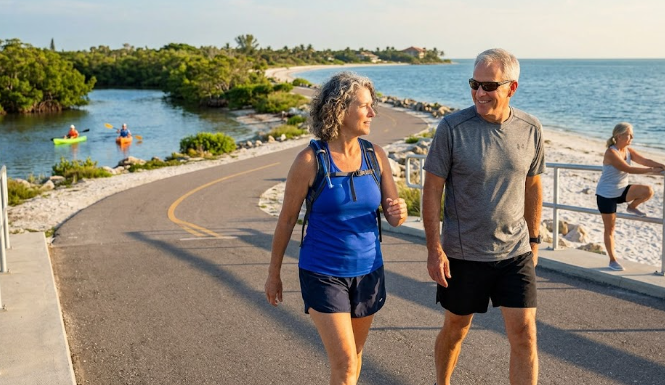
The right starting point for almost any fitness journey after 50 in Southwest Florida is the simplest one: walking on the beach, barefoot, early in the morning.
This is not a consolation prize for people not ready for “real” exercise. It is a physiologically sophisticated intervention that addresses multiple fitness needs simultaneously. Walking on soft, unstable sand activates stabilizer muscles in the ankles, knees, and hips that are essentially dormant during walking on pavement. The lateral micro-adjustments required by uneven terrain continuously engage the gluteus medius and minimus — the muscles responsible for hip stability that are chronically underworked in sedentary adults and are among the first to atrophy after 50. The barefoot component adds the grounding benefits — documented reductions in systemic inflammation from direct contact with the earth’s negatively charged surface — along with the proprioceptive stimulation that maintains balance and sensory acuity in the feet.
The cardiovascular benefit of 45 minutes of brisk beach walking is real and compounding. Walking remains one of the most reliably beneficial activities for adults over 50, with consistent associations with reduced cardiovascular mortality, improved blood pressure, and lower rates of type 2 diabetes in long-term studies.
Where to do it: Naples Beach from 2nd Avenue North toward Lowdermilk Park offers a wide, firm sand corridor excellent for consistent pace walking. Siesta Key Beach in Sarasota has arguably the finest sand on the Gulf Coast — fine quartz crystal that is cool even in summer and ideal for barefoot walking. Barefoot Beach Preserve in Bonita Springs is consistently rated among the best beaches in the country and offers a quieter, more natural setting than the developed beach corridors.
How to progress: Begin with 20–30 minutes at a comfortable pace. Within two to four weeks, extend to 45–60 minutes and introduce a brisk interval — five minutes of faster walking for every ten minutes of moderate pace. Within two months, your cardiovascular baseline and lower body stability will be meaningfully improved.
Trail Hiking — Where the Cardio Gets Serious
Once beach walking has established a baseline, the land-based trail systems of Southwest Florida add terrain variety, longer distances, and the psychological depth of genuine wilderness immersion to your fitness routine.
Hiking activates numerous muscle groups and serves as a comprehensive cardiovascular workout — it helps manage or prevent conditions such as heart disease, osteoporosis, and type 2 diabetes, and offers a wonderful occasion to socialize with peers, friends, or family.
The CREW Marsh trail system in eastern Collier County offers 60,000+ acres of free hiking on wide, well-maintained paths through pine flatwoods and cypress swamp. The Bird Rookery Swamp Trail near Corkscrew Road provides up to 12 miles of configurable hiking on flat terrain, ideal for building endurance without the joint stress of hilly terrain. For Sarasota-area residents, Oscar Scherer State Park and the Legacy Trail — which now spans 18.5 miles from Payne Park to Venice — provide excellent paved and natural surface options for progressive distance building.
The flatness of Southwest Florida’s terrain is frequently cited as a limitation for serious hikers. Lean into it. Flat-terrain cardio at sustained pace builds aerobic base efficiently and allows you to focus on duration and consistency without the recovery demand of elevation change. When you want challenge, you increase pace, distance, and load — not grade.
Outdoor Yoga and Pilates — The Mobility Foundation
No fitness program after 50 is complete without a dedicated mobility component, and no environment makes mobility practice more rewarding than the Gulf Coast at sunrise or sunset.
Pilates has been shown to improve dynamic balance, hip and lower back flexibility, lower extremity muscle strength, and cardiovascular fitness — with a recommendation of 40- to 50-minute sessions three to four times per week. Practicing Pilates or yoga outdoors in Southwest Florida layers the physiological benefits of the practice with the documented parasympathetic nervous system activation that comes from being in a natural environment — the combination produces results that indoor practice alone cannot replicate.
The Gordon River Greenway in Naples, the quiet beach access points north of Clam Pass, and the grassy waterfront areas at Bayfront Park offer excellent outdoor yoga venues accessible year-round. Multiple studios throughout the region offer morning beach yoga sessions during the dry season.
Phase Two: Taking It to the Water
Once you have four to six weeks of consistent walking, hiking, and mobility work establishing your baseline, the water activities of Southwest Florida become available — and they are where the fitness results accelerate dramatically.
Stand-Up Paddleboarding (SUP) — The Full-Body Equalizer
Stand-up paddleboarding is perhaps the most complete single fitness activity available in Southwest Florida for adults over 50. Its benefits across all four fitness domains — cardiovascular, strength, balance, and flexibility — are well-documented, and its low-impact character makes it genuinely sustainable for long-term practice without joint accumulation.
The American Council on Exercise conducted research measuring SUP’s fitness benefits and found that during moderate paddling, your core and back are engaged enough to increase strength. An hour of leisurely paddling burns between 300–400 calories; advanced paddlers paddling at surf or race intensity can burn as many as 1,000 calories per hour.
The balance demand of SUP is particularly valuable for adults over 50. Standing on a moving board in open water requires continuous micro-corrections from the ankle, knee, hip, and core stabilizers — the same muscle groups that govern fall prevention and that decline most predictably with age and inactivity. Regular SUP practice is essentially a continuous balance training session disguised as outdoor recreation.
SUP is a low-impact exercise that doesn’t put excessive strain on your muscles and joints, making it commonly used as a form of physical therapy for athletes in rehabilitation. SUP fitness activates small muscles in the foot and lower leg, making it particularly good for rebuilding foot strength affected by conditions such as plantar fasciitis.
Where to paddle: The protected inner waters of Sarasota Bay near Ted Sperling Park on Lido Key are calm, clear, and ideal for new SUP practitioners. Estero Bay in Lee County offers flat water paddling with excellent wildlife. The back bays of Marco Island and the protected channels behind Keewaydin Island in Collier County provide calm, warm-water paddling with extraordinary natural surroundings.
Progression on the board: Begin with 30-minute sessions on calm water in a wide, stable board (10’+ length for beginners). As balance improves over four to six weeks, extend sessions to 60–90 minutes and begin exploring the transition strokes and direction changes that increase core demand. SUP yoga — practicing yoga poses on the board — dramatically increases core activation and balance challenge and is an excellent option for paddlers who have built basic board stability.
Kayaking — The Low-Impact Cardiovascular Builder
If SUP demands balance above all else, kayaking is the cardiovascular endurance engine of Gulf Coast fitness. A two-hour mangrove paddle engages the upper back, shoulders, core, and arms in the sustained, rhythmic aerobic work that builds cardiovascular capacity without the impact load that makes running problematic for many over-50 joints.
Kayaking’s psychological dimension is equally significant. The environment of a Southwest Florida mangrove tunnel — the enclosed canopy, the dark water, the wildlife proximity — produces a focused, present-moment attention state that researchers describe as restorative attention, associated with measurable reductions in cortisol and anxiety. You are not just getting fit. You are actively recovering from the stress accumulation that ages the body faster than any other single variable.
The Great Calusa Blueway’s 190 miles of marked water trail through Lee County’s coastal estuary system offers progressive distance options from short, easy channels to multi-hour open bay crossings. The Rookery Bay paddle trail system in Collier County and the Lemon Bay Aquatic Preserve in Charlotte County both offer excellent options for building paddling duration and intensity progressively.
For fitness-focused paddling, target sessions of 90 minutes to two hours at a sustained moderate pace — enough to maintain a conversation but not enough to sing. This intensity range optimizes cardiovascular adaptation without exceeding the recovery capacity of joints and connective tissue.
Open Water Swimming — The Complete Aquatic Workout
The warm Gulf of Mexico — between 72°F and 88°F year-round — is one of the most accommodating open water swimming environments in North America, and open water swimming is one of the most complete fitness activities available to anyone at any age.
Swimming is the singular exercise modality that works every major muscle group simultaneously while placing virtually zero compressive load on any joint. For adults dealing with knee, hip, or lower back issues that make land-based exercise painful, open water swimming is frequently the activity that restores fitness and quality of life when everything else causes pain.
The fitness returns from open water swimming compound rapidly. Even moderate swimming intensity — a comfortable crawl stroke that allows conversation — burns 400–600 calories per hour while simultaneously building shoulder, back, core, and hip strength, maintaining spinal mobility, and challenging cardiovascular capacity in ways that surface-level cardio activities do not.
Where to swim: Lowdermilk Park Beach in Naples, Tigertail Beach on Marco Island, and Clam Pass Park in North Naples all offer lifeguarded swimming areas and accessible beach entries ideal for regular open water training. For Sarasota paddlers, Siesta Key Beach’s shallow, gentle entry and famously calm Gulf side provide excellent open water swimming conditions from October through May.
Safety note: Always swim with a buddy or in a visible area, inform someone of your plan, and wear a bright swim buoy for visibility to boat traffic. Check current and tide conditions before extended open water sessions.
Fishing Kayak Fitness — The Stealth Workout
Kayak fishing may not appear on most fitness program lists, but it is one of the most effective sustained physical activities available in Southwest Florida for adults who want fitness without the feeling of exercise. A four-hour inshore fishing kayak session — poling through shallow flats, paddling between spots, making casts, and fighting fish — burns 500–700 calories, works every major muscle group, and requires the focused, present-moment attention that produces genuine mental restoration.
The Charlotte Harbor flats, the Pine Island Sound backcountry, and the Fakahatchee River mouth in Collier County all offer exceptional kayak fishing terrain. The fitness benefits come almost as a side effect of doing something completely absorbing.
Phase Three: The Advanced Challenges
Kitesurfing — The Misconception You Need to Let Go Of
If there is one activity in Southwest Florida that adults over 50 consistently assume is not for them, it is kitesurfing. They watch the kites arcing over the Gulf and imagine an extreme sport for young, fearless athletes. They are wrong about almost everything that conclusion implies.
There is no age limit to kitesurfing. Kitesurfing can be physically demanding but it doesn’t have to be — it’s a sport of finesse, not muscle. You could learn at 16 and enjoy this sport into your 80s and beyond, with many people taught in their 70s and 80s. At Elite Watersports in St. Petersburg — one of the closest certified kitesurfing instruction operations to Southwest Florida — the average student’s age is from 45 to 65 years.
Kiteboarding is a low-intensity exercise, a community-based sport, and learning new movement patterns is good for the aging brain. That last point deserves emphasis: the neurological demand of learning kitesurfing — simultaneously managing kite position, board direction, body weight, and wind conditions — is among the most cognitively stimulating physical activities available. The research on learning complex new motor skills after 50 consistently shows improvements in neuroplasticity, cognitive reserve, and executive function. Kitesurfing is essentially a brain workout delivered through a surf harness.
The fitness returns are extraordinary. Kitesurfing is a full-body workout that engages all of your muscles, including your legs, core, arms, and back. It requires you to use your entire body to control the kite and board, burning calories and building muscle simultaneously. An hour of kitesurfing can burn up to 600 calories. Kiteboarding tones the body especially the upper area, arms, and abdomen — strengthening the abdominal area which in turn improves the abductors and legs. It combines aerobics and resistance exercises, perfect for keeping a balanced weight, toning your figure, and gaining physical strength, all of which keep your heart healthy. It also increases coordination and concentration.
Kiteboarding is perfect as a complement to a healthy lifestyle because it’s only as intense as you want it to be — it can be low-impact and high-intensity or low-impact and low-intensity. It does not require a lot of fitness to start, and you will get into kiteboarding shape quickly once you start.
How to Learn: The standard learning progression is a 10-hour introductory course that covers kite control on land, body dragging in the water using the kite’s power, water starts, and initial riding. By the end of this foundational course, most students can control the kite confidently, execute water starts, and ride short distances. The nearest certified instruction operations to Southwest Florida include Elite Watersports at Skyway Beach in St. Petersburg (operating October through June as prime season) and SA Kitesurfing Adventures in St. Pete, both of which teach with walkie-talkie communication systems that dramatically accelerate learning by allowing real-time coaching while you’re in the water.
Physical prerequisites: There are none beyond basic swimming competence and reasonable general health. Kitesurfing requires no exceptional strength or athleticism to begin. The kite does the power work; your body provides direction, balance, and control. This is why fit 60-year-olds often progress faster than unfit 30-year-olds — patience and body awareness matter more than raw physical capacity.
The honest challenge: Learning kitesurfing requires a genuine time commitment and the willingness to fall many times before you’re consistently riding. This is not a sport that rewards impatience. It is a sport that rewards consistency, attention, and the kind of persistent engagement with a challenging skill that keeps the adult mind genuinely alive. Plan for 10–15 hours of instruction followed by months of solo practice before you’re truly independent. Every session of that journey is physically and mentally beneficial.
Wing Foiling — The Frontier
For adults who have built solid water comfort through SUP and kayaking and want the challenge of a newer, rapidly growing watersport, wing foiling has emerged as one of the most exciting options available. Wing foiling uses a handheld inflatable wing — like a compact kite sail — to generate power while riding a hydrofoil board that lifts the rider above the water surface on a submerged fin.
The hydrofoil component means that once you’re flying — the board’s fin generating lift that raises the deck above the water — the ride is extraordinarily smooth, with no wave impact, no spray, and an almost surreal sense of silent gliding over the Gulf. Wing foiling is less physically demanding than traditional kitesurfing because the wing is handheld rather than harnessed, making it more intuitive for new learners and less physically risky in a wipeout.
The Gulf Coast’s consistent afternoon onshore winds from November through April make the region well-suited for wing foiling. Several watersports operators in the Sarasota and Tampa Bay area now offer wing foiling instruction, and the sport’s rapid growth means instructor availability is increasing.
Inshore Fishing from a Paddleboard or Kayak — The Long Game
For a long-term fitness lifestyle that builds around an activity rather than a regimen, inshore kayak or SUP fishing in the waters of Charlotte Harbor, Pine Island Sound, and the Ten Thousand Islands is among the most complete options available in Southwest Florida.
A consistent practice of two to three half-day paddle fishing sessions per week — working the flats at dawn, fighting redfish and snook from a kayak, poling the shallows on a standup board — will produce, over the course of a season, fitness results that most gym routines cannot match: cardiovascular capacity, core stability, shoulder and back strength, lower body stabilization, and the mental clarity that comes from sustained time in genuinely beautiful, alive natural environments.
Building Your Weekly Program
The key insight of this guide is that fitness after 50 is most effectively built through variety, consistency, and genuine enjoyment — not through any single activity done repetitively until motivation fails. Southwest Florida’s outdoor environment is rich enough to support a genuinely varied program that hits all fitness domains across the week without repetition fatigue.
A well-structured week might look like this:
Monday: 45-minute barefoot beach walk at sunrise, followed by 20 minutes of outdoor mobility work or yoga on the beach. Focus: cardiovascular base, lower body stability, flexibility.
Tuesday: 90-minute SUP session on protected bay water. Focus: core strength, balance, upper body endurance, cardiovascular development.
Wednesday: Rest or light activity — a 30-minute walk, a gentle swim, an easy bike ride on the Legacy Trail. Let Tuesday’s work absorb.
Thursday: Two-hour kayak paddle through a mangrove trail — CREW, Rookery Bay, or Estero Bay. Focus: sustained cardiovascular endurance, upper body and core strength, mental restoration.
Friday: Morning beach walk followed by swimming — 20–30 minutes of open water swimming at a comfortable pace. Focus: full-body strength, joint mobility, cardiovascular conditioning.
Weekend: One longer activity — a full-day fishing kayak trip, a multi-hour hiking session in Big Cypress or CREW, or (when you’ve built to that point) a kitesurfing or wing foiling session. Focus: extended physical engagement, skill development, the deep satisfaction of outdoor adventure.
This program is not rigid. It is a template. Some weeks you’ll paddle more and walk less. Some weeks the wind is perfect for kitesurfing and you go two days in a row. The goal is regular engagement with the outdoor environment — five to six days per week of at least 45 minutes of physical activity — not adherence to a specific schedule.
The Mental Health Component: What the Research and the Experience Agree On
Physical fitness is only part of what outdoor activity in Southwest Florida delivers for adults over 50. The mental and psychological returns may, in the long run, be equally significant.
The documented benefits of regular outdoor physical activity on mental health in adults over 50 include reductions in depression and anxiety comparable in effect size to pharmaceutical intervention for mild to moderate cases, improvements in sleep quality, enhanced cognitive function and memory, reduced risk of dementia, and measurable improvements in subjective wellbeing and life satisfaction.
Southwest Florida adds a specific environmental dimension to these general benefits. The biological richness of the region — the wildlife encounters, the sensory complexity of the mangrove and estuary environment, the quality of Gulf light at dawn and dusk — provides the sensory stimulation and natural beauty that research consistently identifies as uniquely restorative compared to built environments.
People who paddle these waters regularly, who walk these beaches at sunrise and watch ospreys hunt from their kayak and feel the Gulf current against their skin on open water swims, report that the outdoor practice becomes inseparable from their sense of wellbeing. Not an add-on to daily life, but the organizing center of it.
That is the deepest case for getting into shape in Southwest Florida after 50. Not the calories, not the cardiovascular metrics, not the fitness benchmarks — though all of those will come. The deepest case is that this region offers a quality of daily outdoor experience that is genuinely rare, genuinely sustaining, and genuinely worth getting fit enough to fully inhabit.
Getting Started: The Honest First Step
The most common error people make when deciding to get into shape is starting with too many things at once — a new diet, a new gym membership, a running program, a set of fitness goals — and burning out on the complexity within three weeks.
The Southwest Florida approach is simpler. Go outside tomorrow morning. Walk to the beach or to the nearest nature trail. Spend 45 minutes moving in a direction you find interesting. Come home. Do it again the next day.
The activities described in this article — from kitesurfing to open water swimming to backcountry kayak fishing — are the progression, not the starting point. Every one of them is available to you. All of them are being practiced right now by people over 50, over 60, and over 70 throughout this region. The path to each of them runs through the front door and toward the Gulf.
The water is warm. The light is extraordinary. Your first workout starts tomorrow at sunrise.
Consult your physician before beginning any new exercise program, particularly if you have existing cardiovascular conditions, orthopedic limitations, or have been sedentary for an extended period. All watersport activities should be undertaken with appropriate safety equipment and, for beginners, professional instruction.